
Are Citizens Carrying the Climate Burden While Wars Burn Carbon?
How war-related emissions complicate global sustainability goals and public climate responsibility

Across the world, climate change has become one of the defining challenges of our time. Governments are introducing environmental regulations, corporations are publishing sustainability commitments, and citizens are increasingly encouraged to modify their daily behavior in the name of reducing greenhouse gas emissions.
People are asked to recycle, reduce plastic consumption, drive less, and switch to renewable energy. Supermarkets charge for plastic bags. Airlines encourage passengers to offset their flight emissions. Cities promote public transportation and electric vehicles, while households are urged to separate waste and reduce energy use.
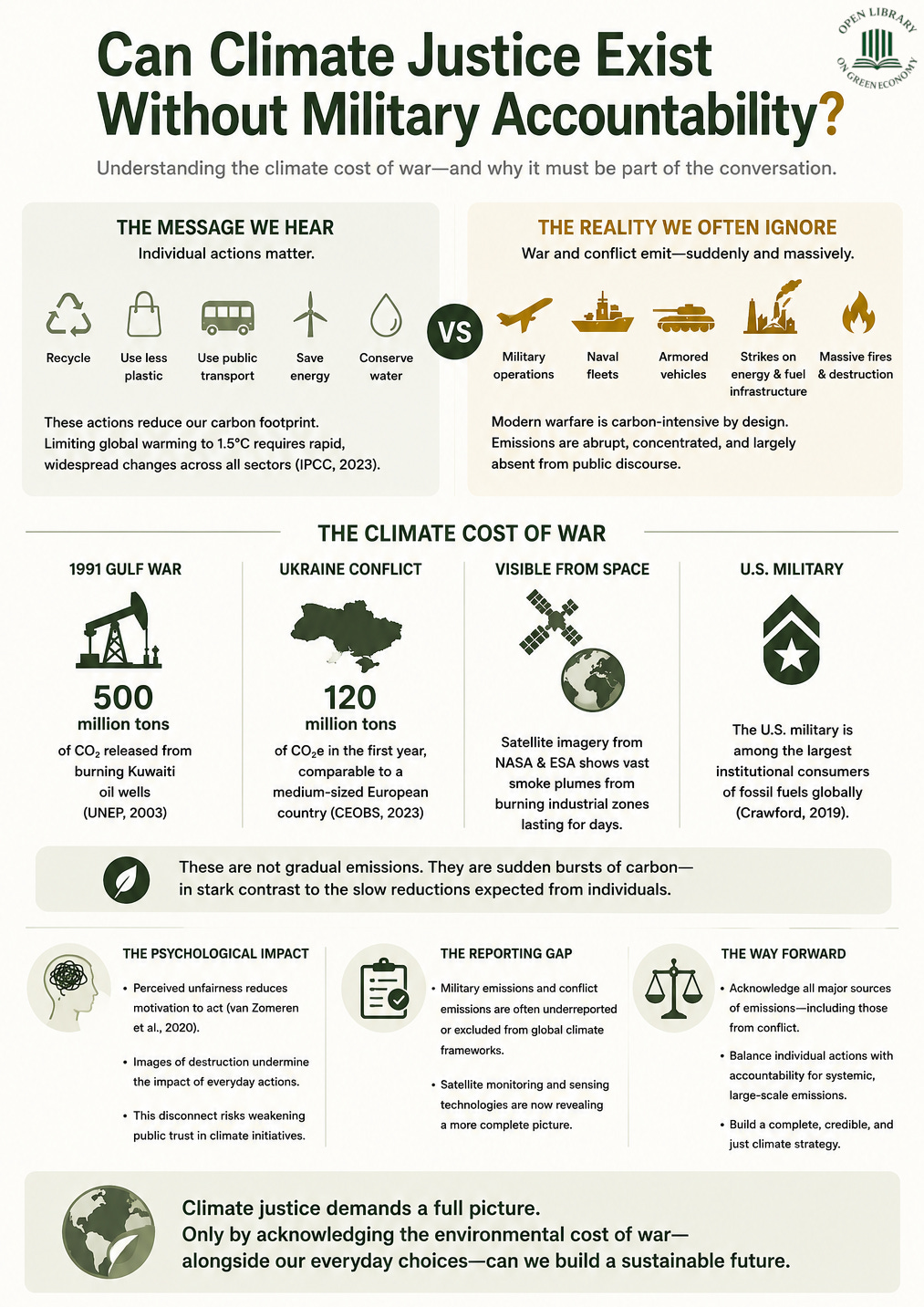
The message is consistent: individual actions matter.
These efforts are designed to gradually reduce the carbon footprint of modern societies. According to the Intergovernmental Panel on Climate Change, limiting global warming to 1.5°Crequires rapid, widespread, and unprecedented changes across all sectors, including behavioral shifts at the individual level (IPCC, 2023).
Yet, alongside these incremental efforts, another reality unfolds.
Large-scale geopolitical conflicts continue across the globe, bringing with them a very different kind of environmental impact, one that is sudden, concentrated, and largely absent from public discourse.
Modern warfare is carbon-intensive by design. Military activities including aircraft operations, naval fleets, and armored vehicles consume vast quantities of fossil fuels. In fact, the U.S. military alone has been identified as one of the largest institutional consumers of fossil fuels globally (Crawford, 2019).
Beyond direct fuel consumption, warfare often targets critical infrastructure such as energy facilities, industrial warehouses, and fuel depots. When these sites are struck, the consequences extend far beyond immediate destruction. Massive fires can burn for hours or even days, releasing enormous quantities of greenhouse gases into the atmosphere within a short span of time. For example, during the 1991 Gulf War, the burning of Kuwaiti oil wells released an estimated 500 million tons of CO₂ into the atmosphere (UNEP, 2003).
More recently, research suggests that the first year of the Ukraine conflict generated approximately 120 million tons of CO₂ equivalent emissions, comparable to the annual emissions of a medium-sized European country (Conflict and Environment Observatory, 2023). These emissions are not gradual; they are abrupt and intense. Satellite imagery from organizations such as NASA and European Space Agency has repeatedly captured vast smoke plumes rising from burning industrial zones during conflicts, sometimes visible from space for days.
These events represent sudden bursts of carbon emissions, in stark contrast to the slow, incremental reductions expected from individuals.
This creates a striking paradox.
On one hand, citizens are asked to take reusable bags, limit water use, and carefully sort their waste. On the other, single events during armed conflict can release emissions equivalent to what millions of individuals are trying to save over extended periods.
For instance, recycling one ton of plastic can save approximately 1.5-3 tons of CO₂ emissions (United States Environmental Protection Agency, 2022). While meaningful, such savings are dwarfed by emissions released during large-scale industrial fires caused by conflict.
This is not to diminish the importance of individual responsibility. Recycling, energy efficiency, and conscious consumption remain essential components of any climate strategy. However, the contrast raises an uncomfortable but necessary question:
Are we focusing too narrowly on individual behavior while overlooking large, systemic sources of emissions?
This issue is environmental as well as psychological. Public climate campaigns often place responsibility at the individual level. Over time, this can shape a mindset where people feel personally accountable for global outcomes. While this can drive positive behavior, it can also lead to frustration or disengagement when individuals perceive that their efforts are insignificant compared to larger, uncontrolled sources of emissions.
Research in environmental psychology shows that perceived fairness and collective participation are critical to sustaining pro-environmental behavior (van Zomeren et al., 2020). When individuals believe that major emitters are not equally accountable, their willingness to act can decline.
When people see images of massive fires caused by conflict, burning oil depots, destroyed industrial facilities, and smoke clouds visible from space, it can undermine the perceived impact of everyday actions like recycling or reducing plastic use. This disconnect risks weakening public trust in climate initiatives.
Despite this, emissions from military activities and armed conflicts are often underreported or excluded from global climate frameworks. Historically, agreements such as the United Nations Framework Convention on Climate Change have allowed countries discretion in reporting military emissions, often citing national security concerns.
However, this is beginning to change.
Advancements in satellite monitoring and environmental sensing technologies are making it increasingly possible to observe and quantify emissions from conflict zones. These tools are revealing a more complete picture of humanity’s environmental impact, one that includes not only economic activity and consumption, but also destruction.
Understanding the climate cost of war does not mean oversimplifying geopolitical realities. Nations face complex security challenges, and conflicts arise from deeply rooted political, economic, and social factors.
But if climate change is truly a global priority, then it demands a comprehensive perspective.
It requires acknowledging all significant sources of emissions, including those that occur during times of conflict.
Public awareness plays a critical role in shaping this perspective. When people understand the full scope of human impact on the environment, they are better equipped to engage in meaningful discussions about policy, accountability, and global priorities.
A balanced climate conversation must include both:
Individual actions, which collectively drive long-term change
Systemic and large-scale emissions, which can rapidly alter climate outcomes
Only by addressing both can societies develop effective and credible climate strategies.
The challenge is technological, political, and also with the narrative.
We must move beyond a simplified story of climate responsibility that focuses solely on personal behavior and instead embrace a more complete understanding of how emissions are generated across all aspects of human activity, including war.
Because only by acknowledging the full environmental cost of our actions, both in times of peace and conflict, we can hope to build a truly sustainable future.
References
Crawford, N.C. (2019) Pentagon Fuel Use, Climate Change, and the Costs of War. Brown University, Watson Institute.Intergovernmental Panel on Climate Change (IPCC) (2023) Sixth Assessment Report: Synthesis Report. Geneva: IPCC.
United Nations Environment Programme (UNEP) (2003) Desk Study on the Environment in Iraq. Nairobi: UNEP.
Conflict and Environment Observatory (CEOBS) (2023) Climate Damage Caused by Russia’s War in Ukraine. Available at: https://ceobs.org
United States Environmental Protection Agency (EPA) (2022) WARM Model Documentation and Emission Factors. Washington, DC: EPA.
van Zomeren, M., Kutlaca, M. and Turner-Zwinkels, F. (2020) ‘Integrating who “we” are with what “we” (will not) stand for: A further extension of the Social Identity Model of Collective Action’, European Review of Social Psychology, 31(1), pp. 122–160.
United Nations Framework Convention on Climate Change (UNFCCC) (2015) Paris Agreement. Bonn: UNFCCC.
Author Note
The author is currently working on an upcoming book titled Missiles, Fire, and Carbon: How Modern Warfare Undermines Global Climate Action, which explores in depth the environmental consequences of armed conflict and its implications for global sustainability efforts.
 | A guest post by
|