
Blue Bond Ecosystem Map
Infographic with Explanation

This chart explains the blue bond ecosystem by showing how money, responsibility, verification, and impact flow between very different actors, from global capital markets all the way down to coastal communities and ocean ecosystems. The key idea is that blue bonds only work because multiple stakeholders play clearly defined roles that connect finance with real conservation outcomes.
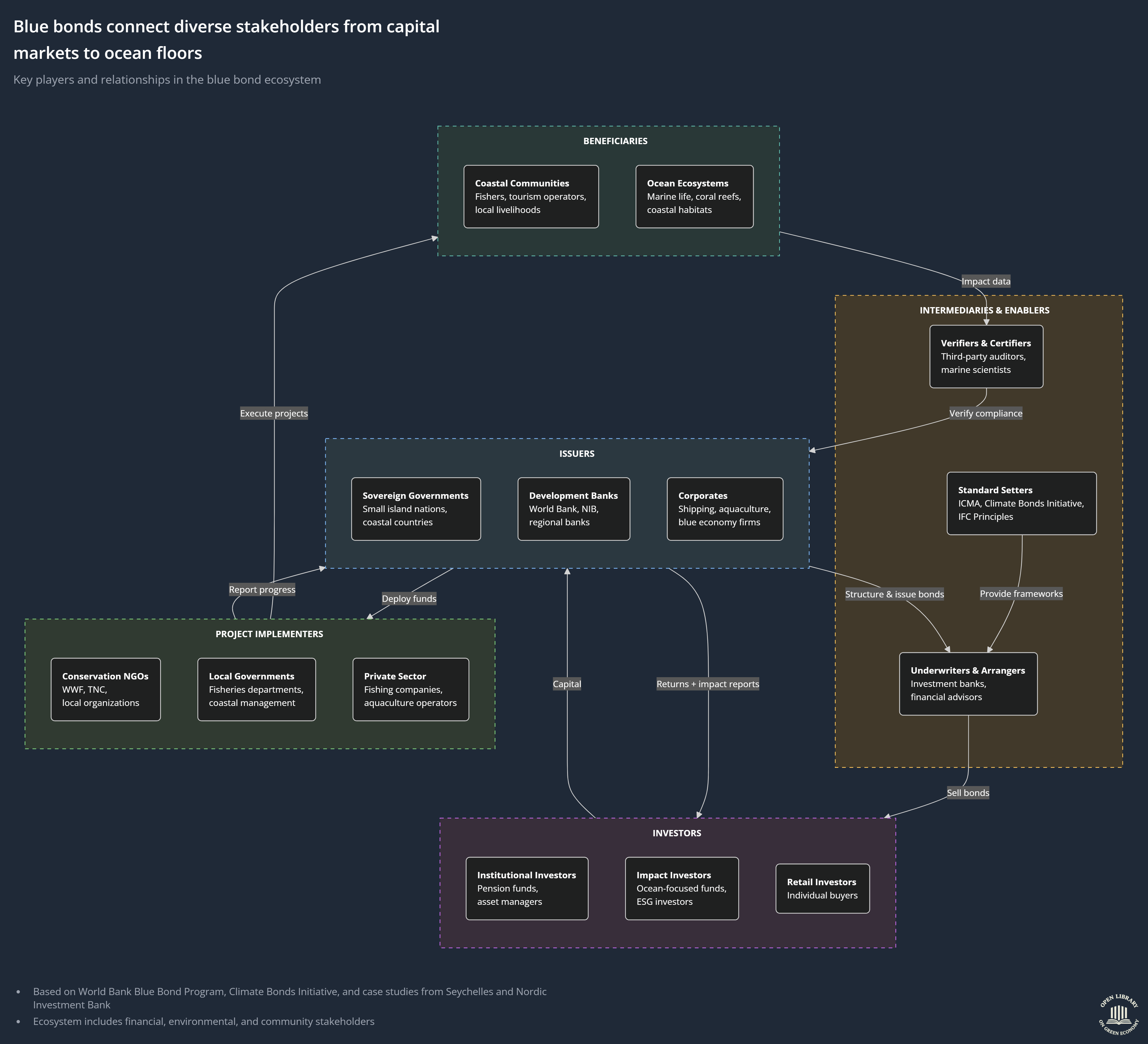
At the bottom of the system are investors. These include institutional investors like pension funds and asset managers, impact focused investors who want measurable ocean outcomes, and in some cases retail investors. Investors provide capital by buying blue bonds. In return, they expect regular interest payments and the return of principal, along with transparent reporting on environmental impact.
That capital flows upward to issuers, who are the entities that actually issue the blue bonds. Issuers are often sovereign governments of coastal or island nations, development banks like the World Bank or Nordic Investment Bank, or corporates operating in the blue economy such as shipping or aquaculture firms. Issuers are responsible for structuring the bond, receiving the funds, and ensuring they are deployed for approved ocean related purposes. They also carry the obligation to repay investors and report both financial and environmental performance.
Once issuers receive capital, they deploy funds to project implementers. These are the actors who carry out the real work on the ground or in the water. Conservation NGOs manage marine protection programs and restoration projects. Local governments oversee fisheries regulation and coastal management. Private sector operators such as fishing companies or aquaculture firms implement sustainable practices. These implementers execute projects, track progress, and report results back to issuers.
The outcomes of these projects directly benefit the beneficiaries. Coastal communities benefit through improved livelihoods, more stable fisheries, and sustainable tourism opportunities. Ocean ecosystems benefit through healthier coral reefs, restored habitats, improved biodiversity, and reduced pollution. These beneficiaries are the ultimate reason blue bonds exist, even though they never interact directly with investors.
Surrounding this entire flow are intermediaries and enablers, who make the system credible and investable. Verifiers and certifiers, including third party auditors and marine scientists, validate compliance and confirm that reported impacts are real. Standard setters like the Climate Bonds Initiative or ICMA provide frameworks and principles that define what qualifies as a blue bond. Underwriters and arrangers, usually investment banks or financial advisors, help structure the bond, manage issuance, and connect issuers with investors.
Information flows back up the system alongside money. Project implementers report progress to issuers. Issuers compile financial and impact reports. Verifiers confirm accuracy. Investors receive both returns and impact data, which sustains confidence and enables future issuances.
A practical example makes this clearer. Consider a small island nation issuing a blue bond to protect its fisheries. Institutional investors buy the bond. A development bank helps structure it. Funds are deployed to conservation NGOs and fisheries departments. New marine protected areas are enforced and fishing practices improve. Verifiers confirm ecological recovery. Investors receive interest payments backed by government revenues. Coastal communities see improved fish stocks and income stability. Every actor depends on the others for the system to function.
The chart shows that blue bonds are coordination mechanisms that align capital, policy, science, and community action into a single ecosystem that connects investors to the ocean floor in a structured and accountable way.