
Can Countries Still Treat Climate Action as Optional?
How the UN General Assembly’s support for the ICJ climate opinion signals a new phase in global climate responsibility.

On 20 May 2026, the United Nations General Assembly took an important step in the global climate debate. It adopted a resolution supporting the International Court of Justice’s landmark advisory opinion on climate change. According to Reuters and the Associated Press, the resolution passed with 141 countries voting in favor, 8 against, and 28 abstentions.
This may sound like another diplomatic development in a long list of climate meetings, resolutions, declarations, and negotiations. But this moment deserves more attention.
The UN’s action gives political and moral weight to a powerful legal message: countries have obligations to address climate change, and failure to act may carry consequences under international law.
The original advisory opinion was issued by the International Court of Justice on 23 July 2025 in the case titled Obligations of States in respect of Climate Change. The ICJ is the principal judicial organ of the United Nations, often described as the World Court. Its advisory opinion is not the same as a binding judgment against a particular country, but it is highly influential because it interprets international law and can shape future litigation, policymaking, diplomacy, and corporate expectations.
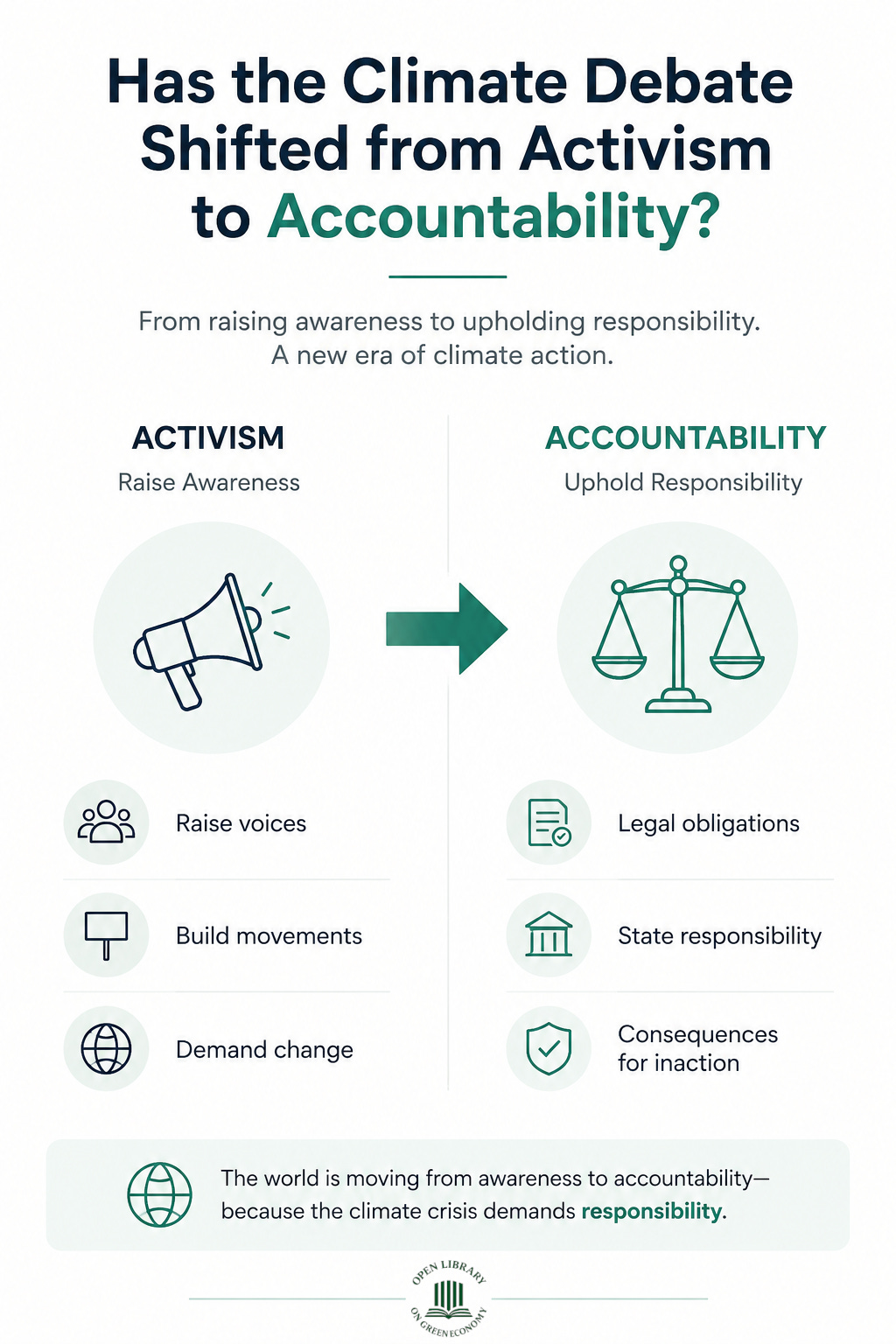
The fact that the UN General Assembly has now endorsed this opinion shows that climate accountability is moving beyond science, activism, and voluntary commitments. It is entering the language of law, governance, responsibility, and justice.
For decades, climate change was mainly discussed as an environmental issue. The conversation focused on melting ice, rising seas, endangered species, deforestation, and greenhouse gas emissions. These remain deeply important. But the global conversation has expanded.
Climate change is now also a legal issue, a human rights issue, a financial issue, a supply chain issue, a national security issue, and a governance issue.
The UK Parliament’s House of Commons Library summary of the ICJ opinion notes that the Court recognised climate change as an existential threat and confirmed that states must act. Other legal analysis has highlighted that the advisory opinion connects climate responsibility not only to climate treaties, but also to broader principles of international law, including duties to prevent significant environmental harm and to cooperate.
This matters because climate damage does not respect borders.
A country’s emissions may contribute to sea-level rise affecting island nations. Industrial activity in one part of the world may intensify heat, floods, food insecurity, water stress, and displacement elsewhere. The question is no longer simply, “Who emitted what?” The question is becoming, “Who had the power to act, who failed to act, and who suffered the consequences?”
Why the UN Vote Matters
The ICJ advisory opinion already carried legal significance. But the UN General Assembly vote gives it wider political visibility.
The resolution was initiated by Vanuatu, a Pacific island nation that has been one of the most visible voices in the fight for climate justice. For small island states and climate-vulnerable countries, this is not an abstract debate. It is about land, identity, livelihoods, future generations, and in some cases, national survival. Reuters reported that Vanuatu played a leading role in advancing the resolution, building on the ICJ’s 2025 opinion.
The Associated Press reported that the resolution supports strong international climate action, including national climate plans aligned with limiting warming, reducing fossil fuel dependency, and addressing climate damage.
The vote also revealed the geopolitical divide. Reuters reported that the United States, Saudi Arabia, Russia, Israel, Iran, Yemen, Liberia, and Belarus voted against the resolution, while several countries abstained.
This divide is important because it reflects the reality of our time.
Climate science is clear, but climate politics remains difficult.
The Geopolitical Reality: Climate Action Is Not Convenient
We are living in a world shaped by war, trade tensions, energy insecurity, inflation concerns, political polarisation, industrial competition, and shifting global alliances. In such an environment, climate action is often pushed aside.
Governments may say they support sustainability but hesitate when climate policy affects fuel prices, industrial competitiveness, voter sentiment, or geopolitical relationships. Companies may publish ESG reports but delay deeper transformation when it affects cost structures, sourcing models, energy choices, or short-term profitability.
Some political leaders may treat climate action as a burden. Some industries may frame regulation as a threat. Some governments may argue that economic growth must come first. Some companies may wait until regulations force them to act.
But the problem is this: climate change does not wait for political convenience.
Physics does not negotiate with election cycles. Rising temperatures do not pause for trade disputes. Floods, droughts, wildfires, sea-level rise, heat stress, and food insecurity do not wait for governments to reach consensus.
This is why the UN adoption of the ICJ opinion matters. It sends a message that even if today’s geopolitics is not fully aligned with climate urgency, the legal and moral direction of travel is becoming clearer.
Delay may still happen. But delay is becoming harder to defend.
The Science Will Eventually Force the Politics
One of the most important lessons from climate change is that postponed action does not make the problem smaller. It makes the required action larger, faster, more expensive, and more disruptive.
If emissions are not reduced early, deeper cuts become necessary later. If infrastructure is not adapted early, disaster recovery becomes more expensive. If supply chains do not become resilient early, businesses face higher operational risks. If countries do not support vulnerable communities early, climate migration and social instability may increase.
This is why climate accountability will not disappear, even if some governments resist it today. The science of climate change is real. The impacts are already visible. And as the crisis intensifies, the pressure on countries and companies will grow.
At some point, every government will have to confront the physical reality of climate change. Every company will have to assess exposure to climate risk. Every supply chain will have to deal with emissions transparency. Every investor will have to price climate vulnerability. Every community will have to ask whether enough was done to prevent harm.
The question is whether climate action will be planned or forced.
What This Means for Companies
Although the ICJ advisory opinion is directed at states, companies should not assume this development is irrelevant to them.
Governments regulate companies. Courts examine corporate conduct. Investors assess climate risk. Consumers demand transparency. Supply chains are increasingly shaped by emissions data, due diligence requirements, and sustainability performance.
If states are expected to strengthen climate action, companies will feel the effect through regulation, reporting requirements, procurement rules, carbon pricing, product standards, litigation risk, and market expectations.
This is especially important for manufacturers, exporters, logistics providers, energy-intensive industries, and companies with complex global supply chains.
Businesses should expect more attention on climate risk governance, Scope 1, Scope 2 and Scope 3 emissions, supplier data, climate transition plans, product carbon footprints, adaptation planning, greenwashing risk, and board-level accountability.
Companies that act early will be better positioned. Companies that wait may face rushed compliance, reputational damage, legal exposure, and loss of market access.
A Turning Point, Not the Final Answer
It is important to be realistic. The UN resolution is not a magic solution. The ICJ opinion does not immediately force every country to change policy overnight. Climate diplomacy remains difficult. Fossil fuel dependence remains deep. Political opposition remains strong.
But turning points in history do not always look dramatic in the moment.
Sometimes they begin as legal language. Sometimes they begin as advisory opinions. Sometimes they begin with vulnerable countries insisting that the world must listen. Sometimes they begin with a vote that does not solve the crisis but changes the terms of the debate.
The UN’s adoption of the ICJ climate opinion is one of those moments.
It strengthens the idea that climate inaction is not merely a policy failure. It may also be a failure of responsibility.
The Road Ahead
The world is entering a period where climate accountability will become more visible, not less.
Governments may continue to disagree. Some companies may continue to delay. Some political leaders may continue to downplay the urgency. But climate impacts will continue to intensify if emissions are not reduced and adaptation is not accelerated.
Eventually, the physical crisis will force the political conversation to catch up.
By then, the cost of delay may be far higher than the cost of action today.
The UN General Assembly’s support for the ICJ advisory opinion should therefore be understood as both a warning and an opportunity.
It is a warning that climate inaction is becoming harder to justify.
It is an opportunity for governments and companies to move faster, build capacity, reduce emissions, protect vulnerable communities, and prepare for a future where climate responsibility is part of normal governance.
The science is real. The legal conversation is evolving. The moral argument is becoming stronger.
And the time for postponing climate action is running out.
References
Associated Press. (2026). UN votes to support strong action on climate change despite US efforts to thwart the effort. Published 20 May 2026. Available at: https://apnews.com/article/90b89dc776e0bece17f2ab4064b7f71e
International Court of Justice. (2025). Obligations of States in respect of Climate Change. Advisory Opinion, 23 July 2025. Available at: https://www.icj-cij.org/case/187
Reuters. (2026). UN backs world court climate opinion; U.S. among few to oppose. Published 20 May 2026. Available at: https://www.reuters.com/legal/litigation/un-backs-world-court-climate-opinion-us-among-few-oppose-2026-05-20/
UK Parliament, House of Commons Library. (2025). Climate Change at the International Court of
Justice. Research briefing, 8 October 2025. Available at: https://commonslibrary.parliament.uk/research-briefings/cbp-10354/
Jus Mundi. (2025). Obligations of States in Respect of Climate Change, Advisory Opinion. Summary of ICJ advisory opinion, 23 July 2025. Available at: https://jusmundi.com/en/document/decision/en-obligations-of-states-in-respect-of-climate-change-advisory-opinion-wednesday-23rd-july-2025
 | A guest post by
|