
What Makes Solar Meaningful Enough to Adopt?
Why understanding what households value, need, and observe may be more important than subsidies alone in determining whether solar technologies are adopted and sustained at scale.

Turkiye has long ranked among the world’s leading adopters of residential solar water heating and has one of the largest installed solar thermal sectors in Europe and the Mediterranean region. Thousands of households served through SELCO Foundation’s distributed solar programs in India, adopted solar lighting because they needed reliable light after dark for their children to study or their small enterprises to stay open. In Germany, rooftop solar photovoltaic installations have repeatedly been shown to cluster in neighborhoods, spreading outward from early adopters in patterns that researchers have associated with social learning as much as with price considerations.
These three cases share a surface similarity: households adopted a solar technology. They share something more important underneath: in none of them does the standard policy explanation fully account for what happened.
The Standard Policy Frame and Its Assumptions
The dominant approach to promoting household solar adoption rests on a coherent set of assumptions. Households are understood as rational decision-makers who weigh upfront costs against lifetime savings, discount future benefits at some implicit rate, and respond to incentives that shift the calculation in the technology’s favor. Barriers to adoption are understood primarily as economic (the upfront cost is too high), informational (households do not know about the technology or its benefits), or attitudinal (environmental motivation is insufficient). Policy responses follow logically: subsidies reduce the upfront cost, awareness campaigns address the information gap, and framing interventions try to activate environmental concern.
This framework has produced real programs and, in some contexts, real results. Scholarship on energy transitions has moved considerably beyond it: researchers working in the socio-technical tradition, including Cherp, Vinichenko, Jewell, Brutschin, and Sovacool (2018) in their meta-theoretical synthesis, have argued for some years that adoption is shaped by economic, political, social, and cultural forces simultaneously. Technology-centered thinking nonetheless remains the dominant logic in many program design and financing contexts, including government subsidy schemes, donor-funded energy access programs, and utility planning frameworks, which is why it is worth examining where it falls short.
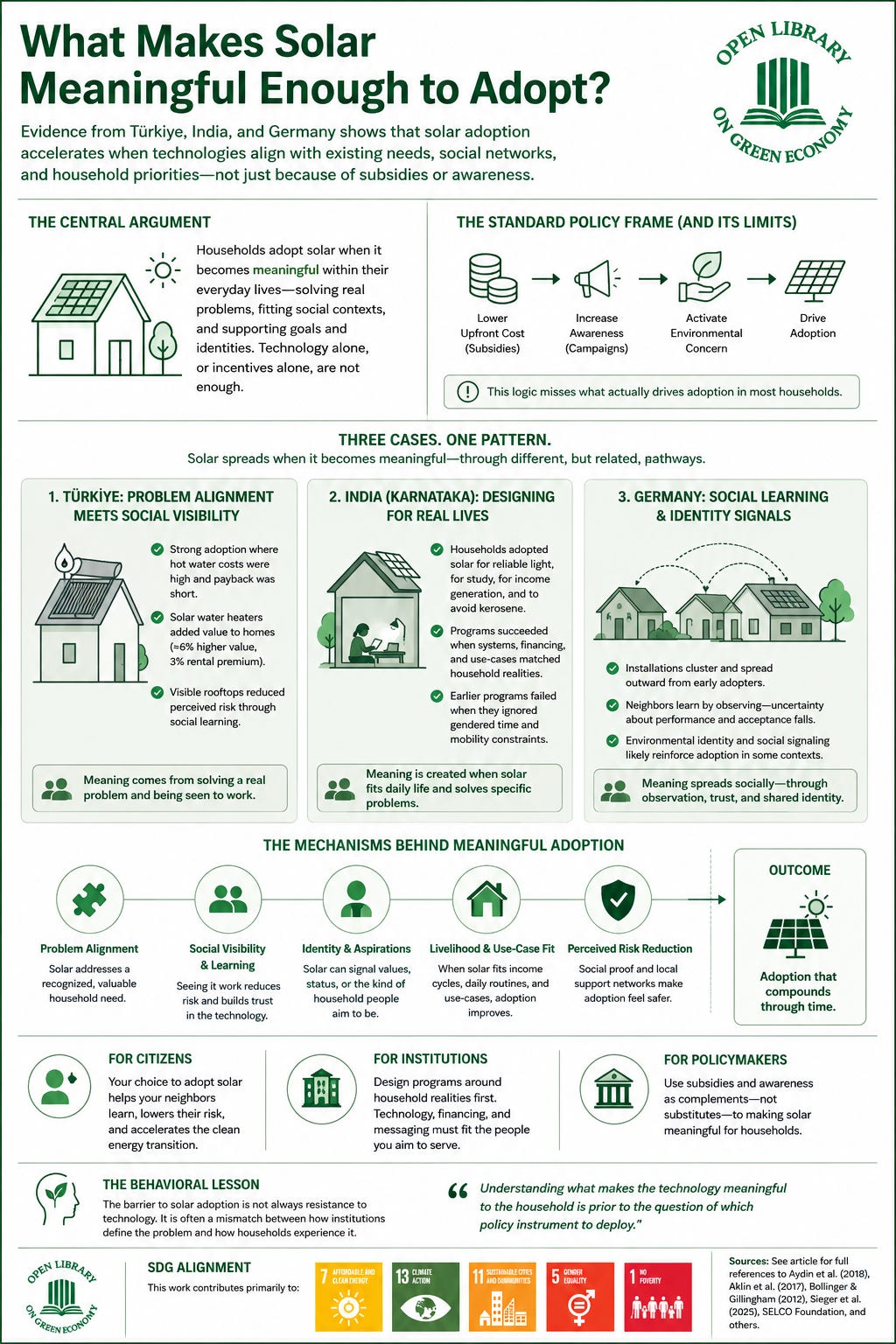
In the theoretical framework established by Stern (2000), household solar installation can be classified as a high-involvement, one-time environmental behavior. It is structurally different from the repeated, low-stakes behaviors (like recycling or switching off lights) that most standard behavioral interventions target. By extension, the evidence from the cases below suggests that households adopt solar when the technology becomes meaningful within existing practices, goals, identities, and constraints. Understanding what makes the technology meaningful to a specific household is prior to the question of which policy instrument to deploy.
Türkiye
Türkiye’s solar water heating sector is one of the most studied cases of large-scale household solar adoption in a middle-income country. An analysis by Aydin, Eichholtz, and Yonder (2018), drawing on a dataset of approximately 23,000 Turkish households, found that the strongest predictors of solar water heater adoption were housing characteristics, income, education, geography, and existing energy expenditure patterns. The technology spread most rapidly in regions where households were already spending substantially on water heating, where the building stock was suitable for rooftop installation, and where the payback period was short and tangible. The same study documented that the presence of a solar water heater raised the assessed value of owner-occupied homes by approximately 6 percent and commanded a 3 percent rental premium, suggesting that the panels carried market-recognized value beyond their direct energy function.
What the Aydin et al. dataset captures directly is the economic and structural fit between the technology and the household. Hot water was a recognized household need. Fuel costs for water heating were a recognized household expense. The evidence suggests that this alignment between household needs and technology characteristics played a central role in diffusion, with the subsidy environment contributing at the margins rather than driving the process.
What the dataset cannot directly observe is the social dimension of how this adoption spread. The visibility of rooftop solar collectors, mounted on the exterior of buildings and observable from the street and from neighboring rooftops, makes social diffusion a plausible additional mechanism. The process at work is what diffusion researchers call perceived risk reduction through social visibility: when households can observe that a technology is installed and functioning in nearby homes, their uncertainty about whether it will work, whether it is socially acceptable, and whether reliable support networks exist all decline together. Research on solar photovoltaic adoption in California by Bollinger and Gillingham (2012) formally quantified this effect, finding that each additional installation in a postal area increased the probability of subsequent installations, with the effect decaying with distance. The underlying mechanism is consistent with the diffusion of innovations framework established by Rogers (2003) and should apply in a similar manner to a visible rooftop technology in Turkiye. The causal claim requires more direct evidence than the Turkish dataset provides, but the pattern is consistent and theoretically coherent.
The Turkish case shows that solar adoption grew because the technology addressed a clear household need, added recognized value to homes, and became visible enough for neighbours to see it working and feel more confident about adopting it themselves.
Karnataka, India
SELCO India, founded in Karnataka in 1995, has spent three decades demonstrating a different version of the same lesson. The organization’s distributed solar model was built around a specific premise: that rural and low-income households would not adopt solar energy systems designed for an abstract user. Systems had to be designed around the actual problems those households were trying to solve, within the actual constraints of their daily lives.
What SELCO’s field experience, documented in its published case studies and referenced in the broader energy access literature, consistently showed was that households adopted solar as a solution to specific, recognized problems, instead of an environmental choice. Reliable lighting after dark enabled children to study, extended the operating hours of home enterprises, reduced dependence on unreliable grid power and on kerosene, whose cost and health effects were recognized burdens. When the technology was designed and financed around these concrete use cases rather than around abstract energy access metrics, adoption improved substantially.
Programs that distributed solar lanterns through central charging stations, requiring households to travel to collect and deposit equipment during daytime hours, struggled in contexts where the primary users were women whose time and mobility were constrained by the demands of domestic work and, in some settings, by social norms governing movement. The technology had been designed for a user who did not match the actual household. When SELCO’s model moved the system to the household, aligned the financing with income cycles rather than with formal credit requirements, and designed around specific use cases, it addressed the mismatch directly.
Aklin, Bayer, Harish, and Urpelainen (2017), in a randomized evaluation of off-grid solar in rural India published in Science Advances, found that solar access produced measurable improvements in energy availability but more modest effects on broader socioeconomic outcomes than advocates had anticipated. The finding is relevant here as a critique of solar adoption as well as a reminder that access and adoption are not the same thing as use aligned with household priorities. The behavioral lesson from the Karnataka case is that adoption improves when the technology is experienced as a solution to a problem the household already recognizes, and struggles when it is experienced as an externally provided option the household is expected to want.
Germany
The Turkish and Indian cases involve households responding to a recognizable problem, hot water or evening light, that the technology addresses directly. A related but distinct pattern appears in Germany, where rooftop solar photovoltaic installations have repeatedly been shown to cluster in neighborhoods, spreading outward from early adopters in patterns that researchers have associated with social learning (Sieger et al., 2025). The mechanism is consistent with what was described in the Turkish case: a visible installation reduces a neighboring household’s uncertainty about whether the technology works, looks acceptable on a German rooftop, and is something local installers and tradespeople are equipped to support.
What the German case adds, plausibly rather than definitively, is a second dimension beyond risk reduction. Some research on residential solar adoption in higher-income European contexts has suggested that environmental commitment and the social signal of having adopted a visible green technology may also play a role alongside practical and financial considerations (Noppers et al., 2014; Vibrans et al., 2023). The evidence for this identity-related dimension is less direct than the evidence for social learning through visibility, and a more confident claim here would require literature specifically focused on pro-environmental identity and residential solar adoption rather than the clustering studies cited above. Taken cautiously, however, the German case suggests that the “meaning” a household attaches to a visible solar installation may include what the technology does as well as what installing it is understood to communicate.
What the Cases Suggest
Taken together, these cases point toward a consistent finding that technology-centered policy frames tend to miss. Households adopt solar when the technology becomes meaningful within existing practices, goals, identities, and constraints. The three cases suggest three related routes through which that meaning is established: problem alignment in the Turkish water heating case, use-case design and livelihood fit in the Karnataka case, and a combination of social learning and, plausibly, identity-related motivations observed in the German case. In each, the technology found traction not because households were persuaded to care about it but because it fitted something they already cared about.
Subsidies can make a technology affordable. Awareness campaigns can make it visible. Neither substitutes for the prior question of whether the technology is meaningful to the household in the terms of its own daily life. The Turkish case suggests that strong alignment between household needs and technology characteristics can support large-scale adoption even in the absence of the intensive behavioral interventions often emphasized in policy discussions. Where that alignment has to be designed, as in early rural Indian solar programs before SELCO and similar organizations restructured their approach, adoption stalls regardless of the instruments applied.
This has a practical implication for how adoption programs are designed. Understanding what makes the technology meaningful to the target household, within the actual constraints of their daily life, is prior to the question of which instrument to deploy. A program that begins with the instrument, the subsidy, the rebate, the awareness campaign, and works backward to the household is likely to find that it is addressing the wrong variable.
The behavioral barrier to solar adoption is therefore not always resistance to a technology. In many cases it is a mismatch between the way institutions define the problem and the way households experience it.
Cherp, Vinichenko, Jewell, Brutschin, and Sovacool (2018), in a meta-theoretical framework integrating techno-economic, socio-technical, and political perspectives on energy transitions, argue that no single analytical lens is adequate to explain how energy technologies spread or stall at the household and community level. The behavioral dimension examined in this piece is one of those lenses, and a necessary one. It is not sufficient on its own.
Implications for Citizens, Institutions, and Policy
For citizens: Understanding that solar adoption spreads partly through social observation and problem recognition rather than purely through individual economic calculation suggests that early adopters carry more weight in the diffusion process than the standard model acknowledges. When households install solar water heaters, they address their own energy needs and simultaneously make adoption feel less risky for others in the community.
For institutions: Program designers who invest in understanding the specific problems target households are trying to solve before selecting an intervention are more likely to achieve durable adoption than those who lead with the technology. The SELCO model’s organizational discipline of designing around the household rather than around the technology is transferable to institutional design more broadly.
For policymakers: Subsidies and awareness campaigns are most effective when embedded within a broader approach that begins with understanding household experiences and motivations. A subsidy for a technology that does not address a problem the household recognizes will produce uptake that is shallow and potentially temporary. A subsidy for a technology that does address a recognized problem will produce uptake that compounds through social diffusion.
Closing Note
The recurring question of this series, what is the actor actually doing and why does the standard policy frame miss it, takes on a specific shape in the case of household solar adoption. Households engage with solar technology through the lens of what it can do for them within their existing daily life: the hot water problem, the unreliable evening light, the electricity bill, the sense of what neighbors are already doing, and in some cases something about who they are or wish to be seen as. Policy frameworks that focus primarily on cost reduction and awareness address some of these motivations and miss others. Programs that begin with what the household already recognizes as meaningful are more likely to produce adoption that compounds through social visibility and normalization. Programs that begin with the instrument and work backward to the household are more likely to find the household unpersuaded.
The next installment will examine household dietary behavior and the green transition, asking what the evidence shows about the gap between stated intentions to eat more sustainably and the food choices that households actually make.
References
Aklin, M., Bayer, P., Harish, S.P., and Urpelainen, J. (2017). Does basic energy access generate socioeconomic benefits? A field experiment with off-grid solar power in India. Science Advances, 3(5), e1602153. https://doi.org/10.1126/sciadv.1602153
Aydin, E., Eichholtz, P., & Yönder, E. (2018). The economics of residential solar water heaters in emerging economies: The case of Turkey. Energy Economics, 75, 285-299. 10.1016/j.eneco.2018.08.001
Bollinger, B., & Gillingham, K. (2012). Peer effects in the diffusion of solar photovoltaic panels. Marketing Science, 31(6), 900-912. https://doi.org/10.1287/mksc.1120.0727
Cherp, A., Vinichenko, V., Jewell, J., Brutschin, E., & Sovacool, B. (2018). Integrating techno-economic, socio-technical and political perspectives on national energy transitions: A meta-theoretical framework. Energy research & social science, 37, 175-190. https://doi.org/10.1016/j.erss.2017.09.015
Noppers, E. H., Keizer, K., Bolderdijk, J. W., & Steg, L. (2014). The adoption of sustainable innovations: Driven by symbolic and environmental motives. Global Environmental Change, 25, 52-62. https://doi.org/10.1016/j.gloenvcha.2014.01.012
Rogers, E.M. (2003). Diffusion of Innovations (5th ed.). New York: Free Press.
Sieger, L., Stein, T., & Weber, C. (2025). Disentangling small-scale solar photovoltaic adoption: A spatial analysis of decision factors and localized interactions in Germany. Energy and Buildings, 344, 116029. 10.1016/j.enbuild.2025.116029
SELCO Foundation. (n.d.). Case studies and field documentation. https://selcofoundation.org/
Stern, P. C. (2000). Toward a coherent theory of environmentally significant behaviour. Journal of Social Issues, 56(3), 407-424. https://doi.org/10.1111/0022-4537.00175
Vibrans, L., Schulte, E., Morrissey, K., Bruckner, T., & Scheller, F. (2023). Same same, but different: Explaining heterogeneity among potential photovoltaic adopters in Germany using milieu segmentation. Energy Research & Social Science, 103, 103212. https://doi.org/10.1016/j.erss.2023.103212
 | A guest post by
|