
Carbon Offset Verification Process
Infographic, Example

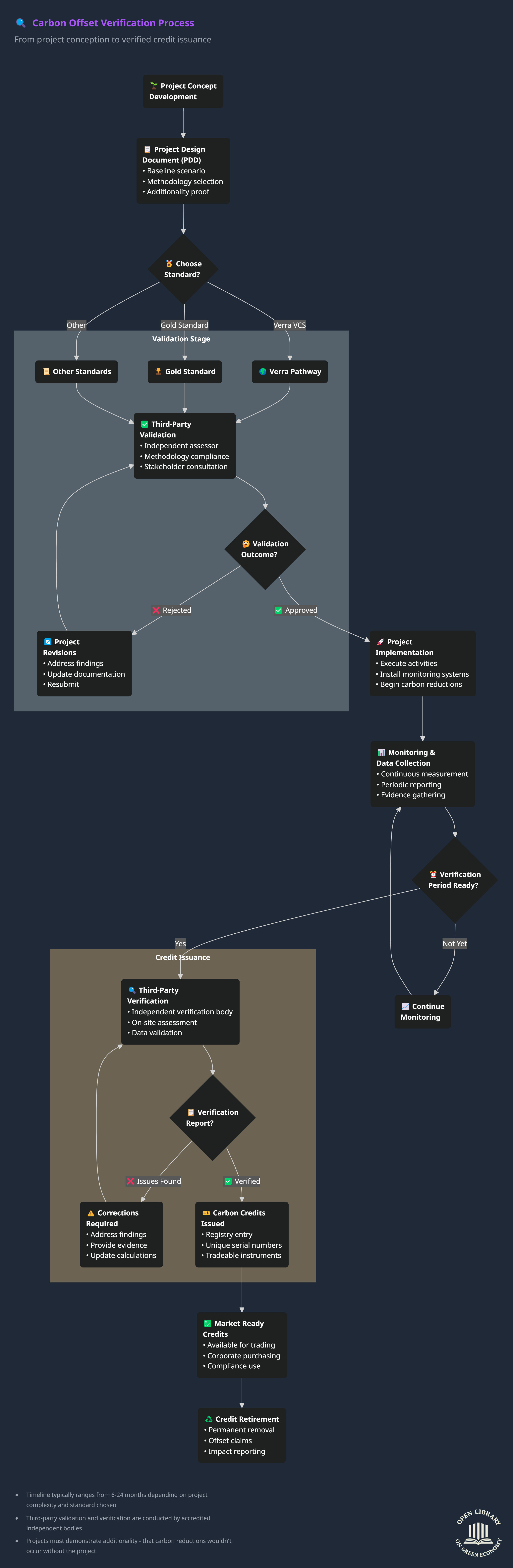
This chart explains the carbon offset verification process, i.e., how a project idea is turned into verified carbon credits that can be traded or retired. Here’s the story in plain flow.
It all begins with project concept development, where an idea is shaped into a plan for reducing or removing carbon. This is followed by creating a Project Design Document (PDD), which sets out the baseline scenario (what emissions would be without the project), the chosen methodology, and proof of “additionality”—showing that the reductions wouldn’t happen otherwise.
Next comes the choice of which standard to follow, such as Verra’s VCS, Gold Standard, or another recognized system. Once a standard is selected, the project enters the validation stage. Here, a third-party validator steps in to check whether the design complies with the rules, consult stakeholders, and assess the methodology. If the project is rejected, it goes back for revisions; if approved, it moves forward.
With validation complete, the project enters implementation. This means carrying out the planned activities, whether that’s planting trees, capturing methane, or installing renewable energy systems, while also setting up monitoring systems to track results. Over time, data is gathered, reports are prepared, and once enough evidence is available, the project becomes ready for verification.
At that point, an accredited third-party verification body reviews the data through site visits, assessments, and validation of the reported numbers. If issues are found, corrections are required, maybe adjusting calculations or providing more evidence. If everything checks out, the project is verified.
Verification unlocks the stage where carbon credits are issued. These credits are recorded in a registry with unique serial numbers, making them tradeable instruments. They are now market ready credits, available for trading, corporate purchasing, or compliance markets. Eventually, credits may be retired, meaning they are permanently removed from circulation and counted toward offsetting emissions, with impact reports documenting the claims.
The whole process typically takes 6 to 24 months, depending on complexity and the chosen standard. Throughout, independent accredited bodies provide the checks and balances to ensure credibility, and every project must prove additionality—that the carbon savings wouldn’t have happened without it.
Examples:
Take Kasigau Corridor REDD+ Project in Kenya, one of the most cited forest conservation offsets. It protects over 200,000 hectares of dryland forest that was at risk of being cleared for charcoal and farmland. Wildlife Works, the project developer, follows the Verra standard. Independent auditors regularly check satellite images, tree plots, and community benefits. Verified credits from this project are then issued and sold worldwide, with buyers ranging from Microsoft to airlines looking to balance their emissions.
Another example is the Bhadla Solar Park in Rajasthan, India, one of the largest solar farms in the world. Projects like this are often registered under Gold Standard or Verra, which confirm how much fossil-fuel-based electricity is avoided through renewable generation. Each megawatt-hour of solar energy displaces an equivalent amount of coal power, and that reduction is turned into certified carbon credits. Multinationals use these credits to claim progress toward renewable energy or net-zero targets.
A more community-focused case is Ecofiltro in Guatemala, which distributes efficient ceramic water filters to rural households. Traditionally, families boiled water using firewood, which meant constant deforestation and smoke emissions. By eliminating the need for burning wood, each filter generates measurable emissions reductions. The data on household adoption and usage is independently verified before credits are issued.
These examples show the different flavors of offsets, for e.g. forest protection, clean energy, household tech; but in every case the verification process is the spine - project design, validation, monitoring, third-party verification, and finally certification into tradeable credits. Without that chain, a credit has no weight.