
Green Mortgage Ecosystem Map
Infographic with Example and Explanation

This chart explains how the green mortgage market actually works by showing all the different players involved and how they interact. A green mortgage isn’t created by a single bank decision. It’s the result of coordinated activity between governments, regulators, lenders, homeowners, installers, certifiers, and property developers. The flow makes it clear that the entire ecosystem has to function together for the market to succeed.
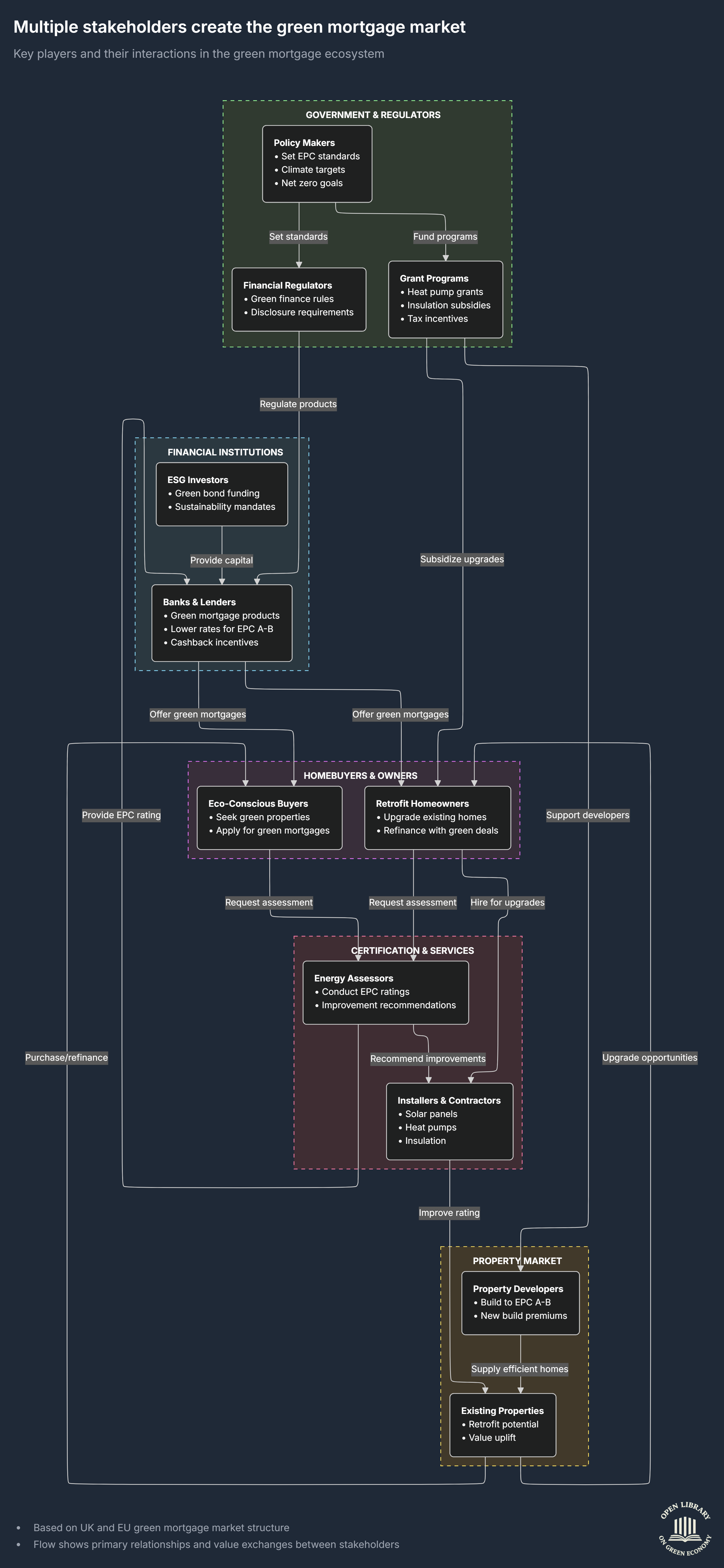
It starts with government and regulators, who establish the foundation. Policymakers set rules such as EPC (Energy Performance Certificate) standards, national climate targets, and net-zero commitments. These high-level targets are translated into specific regulations through financial regulators who set green finance rules and disclosure requirements for banks. Governments also run grant schemes like heat pump subsidies, insulation grants, or tax incentives. These reduce upgrade costs for homeowners. These standards and subsidies shape everything further down the chain.
Financial institutions operate within that framework. ESG-focused investors buy green bonds or demand sustainability-aligned lending, which supplies banks with the capital they need to offer discounted green mortgage products. Banks and lenders then create specific offerings like lower interest rates for homes with EPC A or B ratings, cashback incentives for homeowners who upgrade, or special refinancing terms for retrofitted homes.
Homebuyers and homeowners interact directly with these lenders. Eco-conscious buyers search for energy-efficient homes so they can qualify for better mortgage rates. Existing homeowners use the retrofit path, which includes upgrading insulation, installing solar panels, or switching to heat pumps, and then refinance into a green mortgage once their EPC rating improves. These households rely on EPC ratings to qualify, so they request assessments from energy assessors.
This leads into the certification and services layer. Energy assessors conduct EPC evaluations and tell homeowners what improvements are needed. Installers and contractors, the people who actually fit solar panels, heat pumps, and insulation, carry out the upgrades. Their work directly improves the home’s rating, which improves mortgage eligibility. Without this technical layer, no amount of government policy or financial incentive would produce real world improvements.
Finally, the property market ties everything together. Developers respond to regulations and buyer demand by building new properties to EPC A or B standards. These homes command higher premiums and qualify immediately for green mortgages, pushing the market toward higher efficiency. Existing properties form the other side, they gain retrofit potential and value uplift once they improve energy performance, creating a financial motive for upgrades.
All these layers interact. Government rules push banks to create products. Banks’ incentives push homeowners to demand EPC assessments and upgrades. Installers deliver the improvements that make homes qualify. Developers raise the baseline for new construction. The market becomes a loop where incentives, actions, and outcomes reinforce each other.
A simple real-world example shows how this ecosystem comes alive. A homeowner in the UK with a 20-year-old house wants to lower energy bills. Government heat-pump grants reduce upgrade costs. They hire an EPC assessor, who recommends insulation and a heat pump. A contractor installs them. The EPC rating jumps from D to B. Their bank now offers a green mortgage with a lower interest rate and a £1,000 cashback incentive. Their monthly payments drop, the house value increases, and national climate targets move slightly closer. Every stakeholder contributed: government funded the upgrade, assessors verified it, installers executed it, banks incentivised it, and the homeowner acted on it. That interlocking system is exactly what the chart depicts.
So the chart as a whole shows a living marketplace shaped by policy, finance, technology, and household decisions. All coordinated to accelerate energy-efficient housing.