
How to Accelerate Sustainability in Supply Chain and Procurement?
Mitigating Outliers In Supply Chain

BACKGROUND
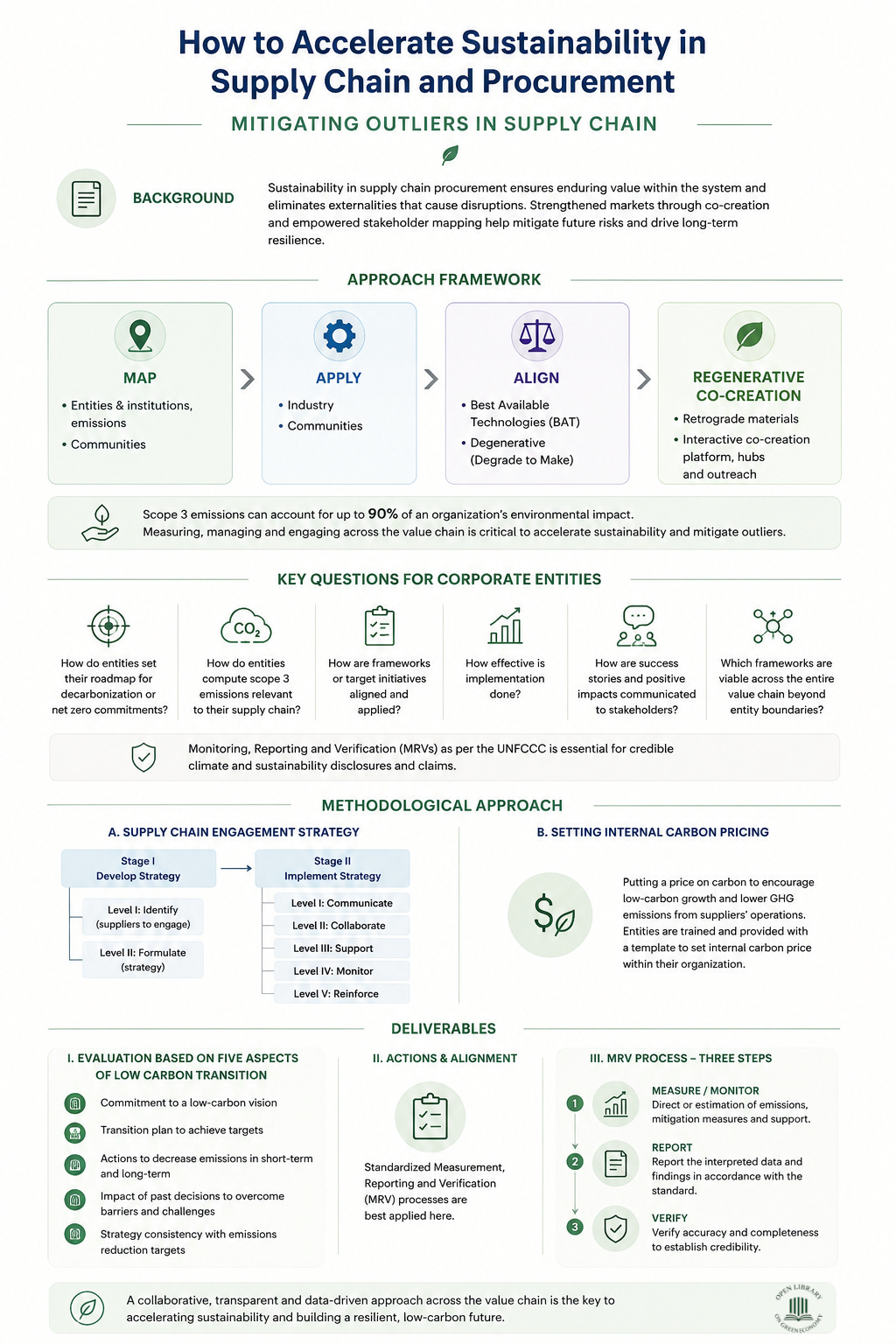
Any corporate entity or for that matter any institutional and organizational setting needs a sound sustainable strategy in their supply chain procurement. What is material to them shapes the dimension of development and resource recovery and upkeep. Efficacy is the basis of procurement policies without which sustainability ceases to fail. Products and services should be enduring within the system and should never be externalities or outliers to the system. As externalities lead to system collapse and supply chain mismanagement. The need of the hour is to strengthen the competitive markets via co-creation that not just shapes the entity level supply chain but also shapes the dynamics of stakeholders. Materiality mapping including stakeholders is done, however stakeholder mapping at the level of empowering intrinsic challenges is not yet evolved, so this work deals with the process and procedures to mitigate future supply chain risks.
METHODOLOGY
MAP
Entities and institutions, emissions
Communities
APPLY
Industry
Communities
ALIGN
Best Available Technologies (BAT)
Degenerative (Degrade to Make)
REGENERATIVE CO-CREATION
Retrograde materials
Interactive co-creation platform, hubs and outreach
According to the GHG Protocol for Emission Inventory, Scope 3 emissions can account for up to 90% of the organization’s environmental impact and so it further places pressure on the part of entities to measure it. Whether it is Life Cycle Assessment (LCAs) using Ecovadis and GABI to track and record downstream emissions or use of sustainable procurement as a pledge to track and record the upstream emissions., it is imperative to accelerate sustainability across the supply chain to mitigate outliers. The sustainable procurement policy and supply chain engagement core competencies were considered to devise decarbonization strategies for more than policies, practices and procedures for implementation that align to sustainability and emissions reductions as a whole.
What Questions Should Be Asked of Corporate Entities?
How entities set their road map for decarbonization or the net zero commitments?
How entities compute the scope 3 emissions, relevant to its supply chain
How framework or target Initiatives are aligned and applied?
How effective implementation is done?
How the success story or visible positive impacts are communicated to the stakeholders?
Which are the framework aligned to: whether SBTi (Science Based Target Initiative), TCFD (Task Force related Financial Disclosure, NBSs (Nature Based solutions), GRI (Global Reporting Initiative), Integrated Reporting (IR), NDCs, NAMAs, UN Global Compact, which is viable to your organization (not just entity level but across the supply chain) including entire value chain, ie beyond the entity boundary or scope of the project?
Monitoring, Reporting and Verification (MRVs) as per the UNFCCC as without which entities can move ahead in their climate and sustainability best practices disclosures and claims.
METHODOLOGICAL APPROACH
The methodology is set on the basis of following stages :
A.Development and Implementation of Supply Chain Engagement Strategy
Stage I : Develop a Supply Chain Engagement Strategy
Level I : Identify (suppliers to engage)
Level II : Formulate (strategy)
Stage II : Implement Supply Chain Engagement Strategy
Level I : Communicate
Level II : Collaborate
Level III : Support
Level IV : Monitor
Level V : Reinforce
B. Setting Internal Carbon Pricing
Internal Carbon Pricing for future proofing supply chain and procurement : Putting a price on carbon to encourage low-carbon growth and lower greenhouse gas emissions. As more and more, business leaders are standing up in support of a price on carbon to have a check on their suppliers’ centric emissions that gets into their operational systems. So entities are accordingly trained on how to set internal carbon price and a template is provided to them for future peruse and for doing it internally within their organization sustainability team.
DELIVERABLES
I. Evaluation Based on Five Aspects of Low-Carbon Transition
Commitment to a low-carbon vision
Transition plan to achieve targets
II. Actions to decrease emissions in the short term and long term
Impact of past decisions in overcoming barriers and challenges
Strategy consistency with emissions-reduction targets
Standardized Measurement, Reporting and Verification (MRV) processes are the best applied here.
III. An MRV process was delivered to multiple sectors under three steps :
Measure or monitor (direct or estimation) of emissions, mitigation measures and support.
Report the interpreted data and findings in accordance with the standard.
Verify accuracy and completeness to establish credibility.
 |
|