
How to Identify Risks & Implement Safeguards in Impact Investing
Infographic with Explanation

This chart explains how investors, regulators, and fund managers can prevent impact washing, which happens when an investment claims to create positive social or environmental impact but cannot actually prove it. The chart shows the risk signals, the safeguards, and the verification steps needed to ensure that any stated impact is credible.
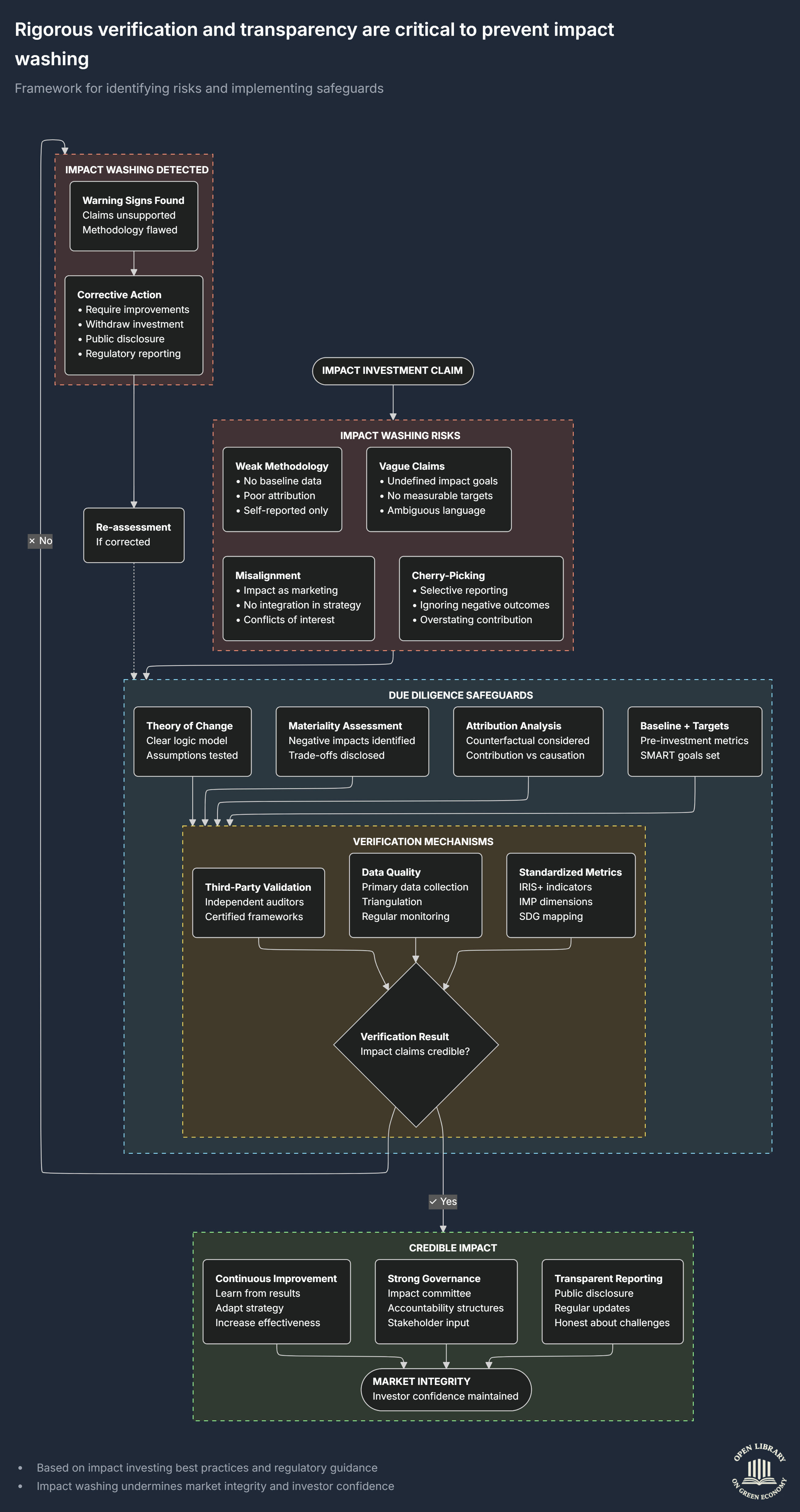
It begins with an impact investment claim. At this stage, several risks can appear. Weak methodology is one of the biggest red flags. This includes having no baseline data, using poor attribution logic, or relying only on self reported numbers. Another major risk is vague claims. Sometimes a fund will say it supports climate action or community well being without having measurable goals or clear definitions. Then there is misalignment, where impact is used mainly as marketing but not integrated into the actual investment strategy. Finally, cherry picking can happen when a fund selectively highlights positive results while hiding negative outcomes or overstating its real contribution.
When these risks appear, investors need safeguards. This is the purpose of due diligence. A solid theory of change explains exactly how an investment leads to impact and what assumptions are being made. Materiality assessment helps identify negative effects and potential trade offs. Attribution analysis looks at whether the investment truly caused the impact or whether it would have happened anyway. Baseline and target setting ensures that goals are specific and measurable from the start. Together these steps create a thorough approach.
Verification mechanisms then test whether the impact claim holds up. Independent third party validation strengthens credibility and removes bias. High quality data collection with triangulation and regular monitoring ensures that results are grounded in evidence. Standardized metrics such as IRIS Plus, the IMP dimensions, or SDG mapping create comparability and prevent overly flexible interpretation.
All of this leads to the central decision point. Are the impact claims credible. If not, the framework sends the process back to corrective action. This might mean requiring better data, changing methods, disclosing flaws, or even withdrawing the investment. If the issues are fixed, the project is re assessed. If they are not fixed, the investment is rejected.
If the impact claims are credible, the investment moves into the next stage. Credible impact requires three practices working together. Continuous improvement means learning from results and adjusting strategy to increase real world effectiveness. Strong governance ensures accountability through structures like impact committees and stakeholder input. Transparent reporting keeps investors and the public informed through regular updates and honest disclosures, including setbacks.
When all of these elements work, market integrity is preserved. Investor confidence rises because stakeholders know that impact is not just a marketing label but something that is tested, verified, and continuously improved. A concrete example of this is when a renewable energy fund claims to reduce emissions. If it cannot show baseline emissions, cannot verify actual reductions, and only reports selectively, it risks impact washing. With proper safeguards, the fund must present verifiable data, allow third party audits, disclose its methods, and report the full picture including challenges. Only then does the market treat its claims as credible.
The chart shows that preventing impact washing is not a single step but a full system of checks, verification, and transparency.