
What are Equator Principles?
10 Principles for Sustainable Project Finance followed Globally

The Equator Principles (EPs) are a risk management framework adopted by financial institutions for determining, assessing, and managing environmental and social risks in project finance.
Voluntary guidelines for managing environmental and social risks
Primarily applies to project finance and related advisory services
Currently in its fourth iteration (EP4)
Adopted by major financial institutions called "EPFIs" (Equator Principles Financial Institutions)
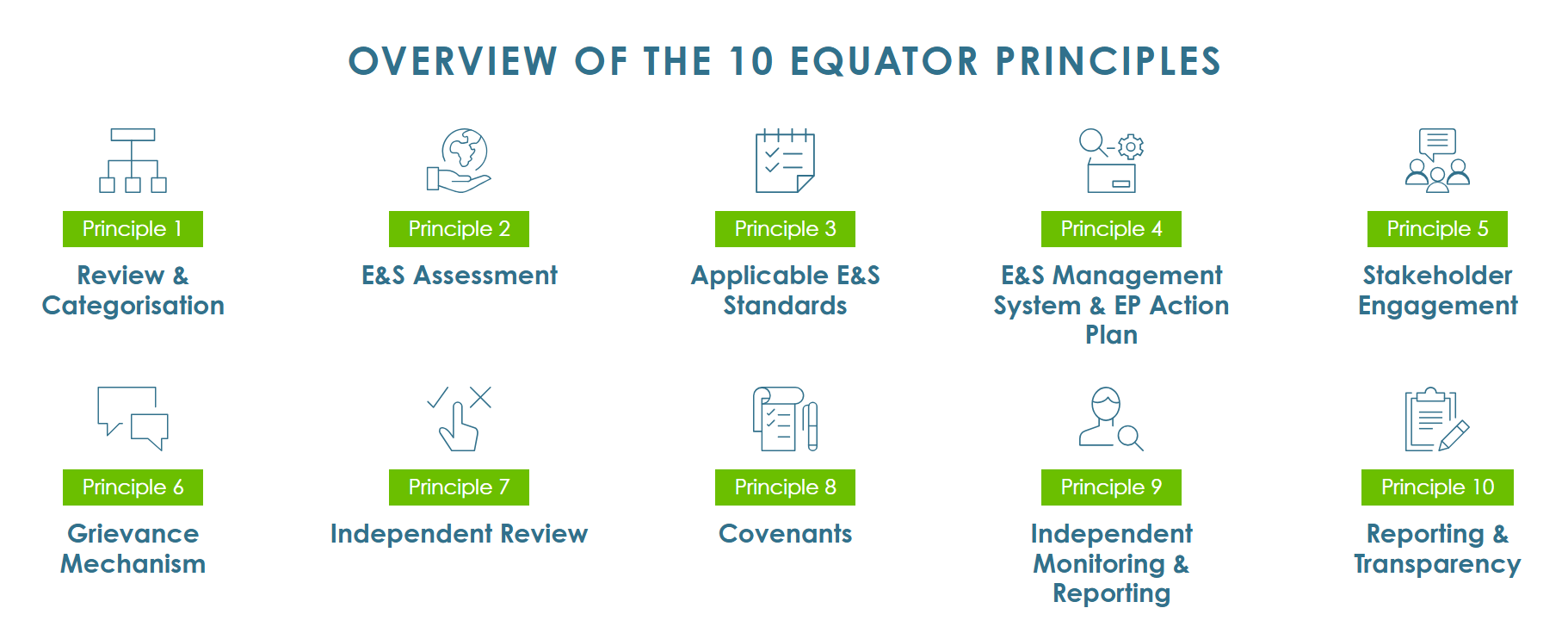
The 10 Principles in Practice:
Review and Categorization - Projects are categorized based on their potential environmental and social risks:
Category A: Significant risks
Category B: Limited risks
Category C: Minimal risks
Environmental and Social Assessment - Requires comprehensive assessment of environmental and social impacts
Applicable Environmental and Social Standards - Projects must comply with host country laws and IFC Performance Standards
Environmental and Social Management System - Requires development of management plans to address identified risks
Stakeholder Engagement - Mandates structured engagement with affected communities
Grievance Mechanism - Requires establishment of mechanisms to address community concerns
Independent Review - Requires independent environmental/social consultant review for high-risk projects
Covenants - Incorporates compliance requirements into financing documentation
Independent Monitoring and Reporting - Requires ongoing monitoring and reporting for certain projects
Reporting and Transparency - Mandates public reporting on EP implementation
The EPs are particularly significant because they:
Set industry standards for project finance
Create common ground for environmental and social risk assessment
Influence project development in emerging markets
Drive sustainable project management practices
Scope of the Equator Principles
The Equator Principles apply globally and to all industry sectors.
An EPFI must apply the Equator Principles to any new Project that meets the below criteria:
Project Finance Advisory Services where total Project capital costs are US$10 million or more.
Project Finance with total Project capital costs of US$10 million or more.
Project-Related Corporate Loans where all of the following three criteria are met:
The majority of the loan is related to a Project over which the client has Effective Operational Control (either direct or indirect).
The total aggregate loan amount and the EPFI’s individual commitment (before syndication or sell down) are each at least US$50 million.
The loan tenure is at least two years.
Bridge Loans with a tenure of less than two years that are intended to be refinanced by Project Finance or a Project-Related Corporate Loan that is anticipated to meet the relevant criteria described in 2 and 3 above.
Project-Related Refinance and Project-Related Acquisition Finance, where all of the following three criteria are met:
The underlying Project was financed in accordance with the Equator Principles framework.
There has been no material change in the scale or scope of the Project.
Project Completion has not yet occurred at the time of the signing of the facility or loan agreement.
While the Equator Principles are not intended to be applied retroactively, EPFIs are required to apply the Principles to the financing of expansions or upgrades of an existing Project.