
What Are Green Elections?
What is the Environmental Cost of Voting, Why it Matters, History of Green Elections, Behavioural Science behind Green Voting, Green Elections in India, and Policy Model for Green Elections

The Hidden Carbon Cost of Democracy
Every few years, the world votes. And when it does, the planet pays a price that almost nobody talks about.
Elections are, in the most literal sense, industrial events. They involve the movement of millions of people, the printing of billions of pages, the erection of tens of thousands of tents and temporary structures, and the generation of staggering quantities of plastic waste(banners, flex hoardings, water bottles, cutlery, flags), most of which ends up in landfills within days of polling closing.
India offers perhaps the most striking illustration of this. The 2014 Indian General Election was the largest democratic exercise in human history at the time. It deployed 10 million election workers across approximately 1 million constituencies. Worker payouts alone amounted to INR 150 billion. Setting up polling booths cost another INR 100 billion. Security, logistics, communications, and training added further tens of billions. In total, the estimated direct expenditure came to around INR 320 billion (roughly USD 3.5 billion at the time), with indirect costs potentially running into billions more (right2vote.in, 2025). And that figure does not even begin to account for the environmental cost: the carbon emissions from vehicular movement, the plastic waste from campaign materials, the noise pollution from public address systems, or the electricity consumption of millions of temporary installations.
Beyond India, the picture is no different. In every democracy, elections are what researchers Hazarika, Siddiquee, Singh, Hasam, and Lal (2025) describe as “periodic, intense, short-duration surges” of material consumption. The waste burden per square kilometre per day during an active election campaign is unusually high. Elections concentrate human activity, logistics, and consumption into a brief, compressed window. These are the conditions under which environmental damage is most acute and least managed.
The question that follows is this: if we are serious about decarbonisation as a civilisational project, why have we consistently treated democracy’s own carbon footprint as someone else’s problem?
Green Elections are the answer to that question. And understanding them properly requires going deeper than recycled banners and tree-planting photo opportunities.
What Green Elections Actually Are
The term “Green Election” is deceptively simple. At its most basic, it describes an electoral process that consciously minimises its environmental impact. This can be done by replacing plastics with biodegradable materials, reducing paper waste through digital substitution, cutting carbon emissions from logistics, and using ecological gestures like sapling distribution to reinforce civic participation.
But that surface definition misses the more interesting and consequential dimension of what Green Elections represent. They are not simply a cleaner version of the same event. They are, as the research evidence increasingly suggests, a redesign of democracy’s production technology.
Think of an election not as a political event but as a supply chain. It involves vendors, logistics networks, material procurement, temporary infrastructure, communications, last-mile delivery of information and equipment, and the mobilisation of millions of people. Every one of those components carries an environmental cost. Green Elections ask what happens when you systematically redesign each component to reduce that cost, without compromising the integrity, accessibility, or legitimacy of the democratic process itself.
The answer, as India’s experience between 2019 and 2025 demonstrates, is that it can be done. Not perfectly, not everywhere at once, and not without tension. However the trajectory is clear and the evidence is growing.
How the Idea Took Shape
The origins of Green Elections are worth understanding, because they follow a pattern common to many sustainability transitions: the idea did not begin inside the institutions that eventually had to implement it. It began outside them.
The first knowledge shock came from the global reckoning with plastic. When society began to confront the fact that plastic, which was long celebrated as a cheap, democratic, universally accessible material, was also structurally non-biodegradable and globally persistent (The Guardian, 2018), the implications spread outward into every domain of public life. Governments that had plastered election campaigns in PVC banners and flex hoardings for decades suddenly found themselves caught between two commitments: delivering elections as usual, and meeting their own anti-plastic pledges.
India’s early national signals were directed at “plastic-free India” as a general aspiration rather than at elections specifically (Reuters, 2019). But the logic was inescapable. If daily life had to reduce plastics, why should elections be exempt?
The first operational response came not from election administrators but from waste management practitioners who had already been applying “green protocols” to large religious festivals in India. During the 2019 general election cycle, a few districts began borrowing those protocols, like waste sorting, steel tumblers instead of disposable plastic cups, organised waste pickup, and applying them to polling operations (The Better India, 2019). Crucially, this was a transfer of practice, not yet a coherent policy framework. The term “Green Election” did not yet exist as a recognised category.
By 2023, the Election Commission of India (ECI) had moved from informal encouragement to regulatory insistence. Anti-plastic norms in campaigns turned into rules from advisory guidelines (Indian Express, 2023). Then 2024 became, in the researchers’ words, the true inflection point.
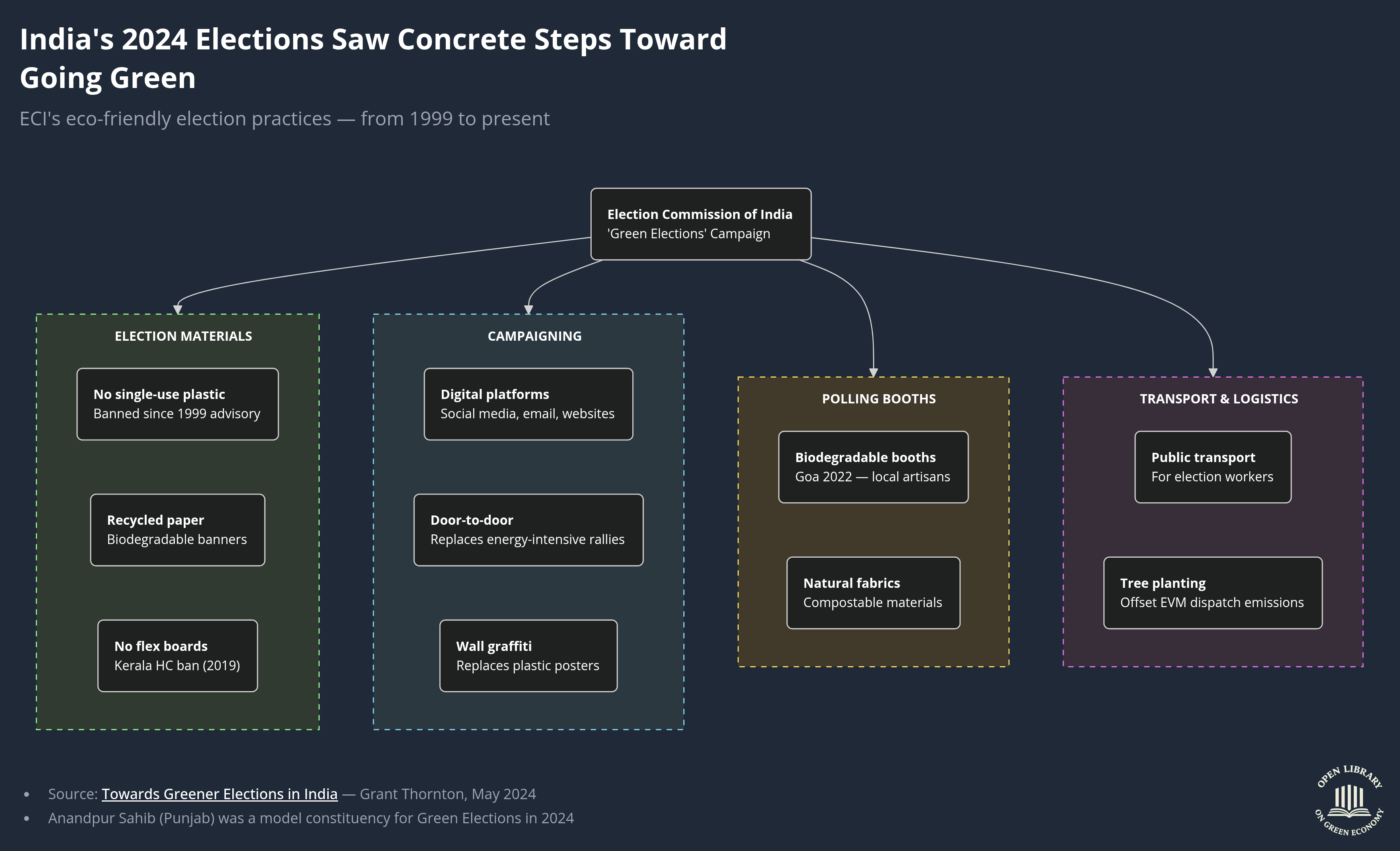
Two things happened simultaneously. First, formal handbooks with operational guidance on green electoral protocols were issued in several states, making waste reduction and material restrictions mandatory by order rather than suggestion (New Indian Express, 2024). Second, and this is the shift that changed the conceptual frame permanently, extreme heat directly entered the picture. During the 2024 Indian general elections, voters and polling workers were documented standing in 45°C heat, with clear health risks (Reuters, May 2024). The Green Election conversation went from being only about waste to whether democracy itself was becoming climatically fragile.
The year 2024 was, as Forbes noted, a record year in which roughly half the world’s population went to the polls. A United Nations study conducted that year found that 80% of global voters wanted climate action from their governments. Yet Reuters analysis showed that climate barely featured in the actual campaigns (Reuters, June 2024). Here was the central paradox laid bare: climate risk had become physically present in the electoral process, in the form of heat that endangered voters, while remaining almost absent from electoral messaging.
By 2025, the United Nations Development Programme had published a practical guide entitled Elections for People and Planet, moving the field decisively beyond waste reduction into the concept of climate-resilient election logistics (UNDP, 2025). The highest levels of global governance had reached the same conclusion that Indian district administrators had been quietly working toward since 2019. Decarbonising elections as risk management discipline.
The arc of this evolution, as identified in the research, runs through four distinct phases:
Plastics consciousness (2018–2019): Society recognises plastic as a structural problem; early electoral applications are borrowed from festival waste management.
Political ecology of climate (2021): Academic and media frameworks begin connecting electoral systems with environmental risk, though the conversation remains conceptual.
Extreme heat risk activation (2024): Climate enters electoral administration as a direct operational hazard, and not a governance topic.
Climate-resilient and decarbonised electoral administration (2025 onwards): International institutions formalise Green Elections as a risk management discipline; national and local governments begin mandating green protocols by law.
The Economics of Green Voting
One of the most persistent myths in sustainability discourse is that going green costs more. This assumption has shaped decades of policy resistance and corporate hesitancy. Green Elections offer one of the cleaner empirical refutations of that myth.
A pan-India analysis of 543 parliamentary constituencies found that Green Election campaigns are associated with approximately 45% lower incumbent campaign spending compared to conventional resource-intensive campaigns (Prajapati, 2025). That figure deserves some dwelling upon. So green campaigning is not only cleaner; but also cheaper. By roughly half.
The mechanism is straightforward when you trace it. Conventional election campaigns are built around material abundance: the more banners, the more vehicles, the more printed materials, the more visible the candidate. Green campaigns invert this logic. They substitute digital communication for print, community networks for paid contractors, biodegradable or reused materials for single-use plastics, and symbolic gestures like sapling distribution for expensive promotional merchandise. The cost reduction is real and measurable.
This connects to a broader pattern identified in environmental economics. Research on EU Recovery and Resilience Plans found that higher prioritisation of environmental Sustainable Development Goals (SDGs) is positively associated with higher expected short-term GDP growth, suggesting that environmental orientation does not simply “subtract” from economic performance (Limosani et al., 2025). The classic green-versus-growth trade-off argument is getting weaker with more and more evidence.
For finance ministers and institutional investors, this is a structural signal worth watching. Green transitions that are well-designed tend to generate efficiency gains, not just cost burdens. The electoral domain is no different.
Why People Vote Green
The standard narrative about “green voters” treats environmental concern as a matter of values and identity: people vote green because they care about the environment, and people who do not care, do not vote green. This framing has always been too simple, and the evidence now makes that clear.
Research across multiple political systems shows that environmental electoral behaviour is not primarily driven by environmental attitudes. It is driven by incentive structures.
Consider the evidence:
In the US House of Representatives, tariff reductions under NAFTA between 1990 and 2000 measurably reduced legislative support for environmental bills. When local economic interests shifted, environmental positions shifted with them, not because anyone’s values changed, but because the payoff calculation changed (Cherniwchan & Najjar, 2025).
In Italy, survey evidence shows that when climate risk becomes personally salient, through experience of natural disasters or through having children whose futures are at stake, the traditional economy-versus-environment trade-off effectively disappears. People vote for pro-environment parties even when they believe green policies may reduce short-term economic output. Risk salience, not ideology, is the decisive variable (Salvarani et al., 2025).
In European cities, left-wing municipal governments show systematically higher rates of entering the European Green Capital Award cycle. Party ideology shapes institutional action through a direct chain (Sumeghy & Schmeller, 2025).
Female parliamentarians are now demonstrably causal drivers of energy justice outcomes in democratic systems, consistent with ecofeminism-linked risk preferences (Njangang et al., 2025).
The synthesis from all of this is stated with precision in the research: “Green voting emerges not as identity politics or a moral add-on, but as a risk-interest equilibrium.” Environmental electoral behaviour is political economy. Full stop.
For Green Elections specifically, this means the following. The adoption of green practices in electoral administration is not primarily a function of how “environmentally conscious” a society or administration happens to be. It is a function of whether the incentive structures support it. When green campaigning cuts costs by 45%, when climate risk creates real operational hazards for polling operations, when institutional frameworks make green protocols the path of least regulatory resistance, green behaviour follows. Change the structure, and the behaviour follows. Wait for attitudes to change first, and the wait will be indefinitely long.
There is also a behavioural layer operating at the individual voter level that the Indian experience illuminates particularly well. Research on what is called the “warm glow” effect shows that people derive utility not only from material outcomes but from acting in accordance with moral norms (Jerit et al., 2024). Environmental symbols, a sapling received at a polling booth, a bamboo-constructed voting centre, a plastic-free zone, function as moral cues. They signal to the voter that this act of voting is aligned with values of care, responsibility, and community. That psychological activation increases both the emotional salience of the voting experience and the likelihood of participation.
The high recall rate of voter awareness campaigns in places like Sirsa, where saplings were distributed, compared to areas relying on conventional slogans, offers direct evidence that environmental cues generate deeper cognitive engagement than standard political messaging. A sapling is tangible, emotionally resonant, photographable, and socially shareable. A slogan is none of those things.
Green Elections in India
The India case study, drawn from research across Bihar, Punjab, Maharashtra, Gujarat, Jharkhand, and Tamil Nadu offers the most detailed existing evidence of how Green Elections work in practice. Each state provides a different context, a different set of challenges, and a different version of the same underlying logic.
Bihar
Bihar is where Green Election operational innovation was arguably strongest, particularly in rural and semi-urban settings. The strategy centred on saplings as the primary civic cue. The first five voters at selected polling stations were given plants. The 50th voter received one as well. Four polling stations in Kudhni were designated “Green Special Booths,” each distributing 50 saplings on polling day. Across the Kurhani constituency, nearly 1,875 plants were distributed in a single election day.
In the urban centre of Patna, the approach shifted from mass plantation to aesthetic redesign of the polling experience. Thirteen green polling stations were established, featuring selfie zones with green backdrops, rangolis depicting environmental messages, and banners promoting water conservation. The design logic was explicitly targeted at urban youth and at amplifying the message digitally through social media sharing.
The Bihar model relied heavily on Self-Help Groups (SHGs) and Panchayat networks for ground-level delivery. SHG members conducted door-to-door visits, distributed voter slips, and targeted women voters who might otherwise have disengaged from the process. This community-embedded approach kept costs negligible while achieving significant reach.
Jharkhand
Jharkhand is the most instructive case for anyone interested in whether Green Elections can scale beyond individual constituencies into a replicable system.
In the Koderma Lok Sabha constituency, green booths were transformed into full Green Polling Centres operating under zero-waste and plastic-free policies. The booths were decorated with bamboo and paddy straws; sheds used “Kullu” or “Sikki” grass instead of plastic tarpaulins; PVC flex banners were replaced with hand-painted cloth or paper. The polling centres were designed explicitly to celebrate Jharkhand’s ecological and cultural identity, making the voting experience a celebration of local heritage rather than an administrative chore.
Critically, Jharkhand also demonstrated the logistics of scaling. Multiple constituencies and districts used standardised templates, controlled material inventories, and modular messaging systems. This is what the researchers call the “sustainable franchise” logic: the same operational model, adapted to local conditions, deployed consistently across a wide geography. The Anganwadi network, present in almost every habitation in Jharkhand and Bihar, served as the last-mile delivery infrastructure, with Anganwadi workers leveraging their household-level knowledge to promote both voting and environmental awareness simultaneously.
Gujarat
Gujarat’s contribution was methodological: demonstrating how to move from tokenism to scale.
In the Visavadar election, 29 polling booths across 15 villages in the Visavadar, Bhesan, and Junagadh talukas were designated as green polling booths simultaneously. They were constructed using entirely biodegradable and locally sourced materials. Bamboo replaced metal barricades. Asopalav and mango leaves decorated the booths, sourced and arranged by local communities. Women trained at Vaans Kaushalya Vardhan Kendras (Bamboo Skill Centres) produced furniture, barricading materials, and decorations. Student volunteers from the National Service Scheme (NSS) and National Cadet Corps (NCC) served as “Green Ambassadors,” managing queues, assisting voters with disabilities, and facilitating sapling and seed ball distribution.
The Gir Forest’s proximity to Visavadar brought the Forest Department directly into the operation as a supplier of saplings, integrating its own afforestation targets with the electoral process. This is a small but telling detail: Green Elections, where well-designed, create alignment between institutional mandates that normally operate in isolation from each other.
Punjab
Punjab offered the hardest test: a state where political competition is intense, campaigns are celebrity-coded, and voter mobilisation is resource-intensive. If Green Elections could penetrate Punjab, they could penetrate anywhere.
The Punjab approach emphasised institutional design over community mobilisation. Green booths at Anandpur Sahib constituency were used to minimise plastic across the entire EVM (Electronic Voting Machine) management chain, covering training, dispatch, collection, and counting. In total, 47,266 saplings were distributed across 2,068 polling booths. The District Election Officer collaborated with the State Forest Department to procure saplings at scale. An “Awareness Run for Green Election” mobilised public visibility. Engagement with universities, including Lamrin Tech Skill University, Punjab Agriculture University, and ISB Mohali, extended the campaign into academic institutions.
Political parties were directed to use jute bags, embrace digital platforms, and plant a sapling daily before commencing campaigning. The campaign thus worked simultaneously at the administrative level (making green protocols part of the operational structure) and the political level (encouraging parties themselves to adopt environmentally visible practices).
Maharashtra
Mumbai’s experience in the Anushakti Nagar and Chembur constituencies offers the most honest assessment in the entire study. The green initiative there was, as officials themselves concluded, “partially successful.”
The urban strategy relied heavily on digital substitution: digital vouchers, online monitoring systems, and digital documentation to reduce paper trails, alongside biodegradable materials in all polling supplies and sapling distribution to some voters. First-time voters received certificates acknowledging their role as “good and responsible citizens.”
But officials found that environmental incentives alone were not sufficient to change the deeply entrenched voting behaviours of Mumbai’s electorate. Urban election days have an additional problem: they tend to function as leisure holidays rather than civic occasions, with many residents treating the day off as an opportunity to leave the city or relax rather than vote.
The response was conceptual: reframing election day not as a “holiday” but as a “Holy Day of democracy” requiring active participation. The initiative succeeded in its secondary goal of creating a blueprint for plastic-free urban elections, even where it fell short of its primary goal of substantially increasing voter turnout. This is an honest finding that deserves respect. Green Elections are not a silver bullet for voter engagement. They are one tool among many, and their effectiveness varies significantly by urban-rural context.
Tamil Nadu
Tamil Nadu marked a shift in the Green Election model from isolated innovations to a more structured administrative framework. During the 2026 Tamil Nadu Legislative Assembly elections, the Dharmapuri and Paapireddipatti constituencies implemented “Green Election 5.0” under the guidance of Dr. Heera Lal, IAS. Unlike earlier experiments that focused mainly on booth-level activities, Tamil Nadu embedded green practices into election planning, coordination, training, and voter outreach itself.
A formal Green Initiatives Committee was created bringing together the Revenue Department, Forest Department, Agriculture and Horticulture Departments, Pollution Control Board, educational institutions, civil society groups, and local business associations. The initiative operated through a detailed SOP-based system assigning responsibilities, timelines, and measurable outcomes for activities such as sapling distribution, green booth setup, media engagement, staff training, and documentation.
The Tamil Nadu model also integrated Green Election messaging directly into SVEEP activities. Environmental awareness was combined with voter mobilisation through school pledge ceremonies, student video messages, cycle rallies, kolam competitions, folk performances like Villupattu and Karagam, and WhatsApp outreach through self-help groups and schools. College students were appointed as “Brand Ambassadors” to spread the campaign among youth and local communities.
At the polling booth level, the first five voters at every booth received saplings supplied by the Forest Department, with native species such as mango, neem, teak, and tamarind selected for local suitability. Green Model Booths used cloth banners, biodegradable signage, potted plants, and zero-plastic arrangements. Unlike earlier state experiments, Tamil Nadu placed strong emphasis on documentation and scalability, treating the election as a replicable administrative model rather than a one-time awareness campaign.
The Seven-Component Policy Model
The research distills the operational learning from all five states into a seven-component policy design model. It is worth laying out in detail, because it is genuinely transferable to any civic engagement context, not just elections.
1. Cue Selection - The most important design decision is choosing the right environmental cue. A cue must be:
Simple and immediately understood
Visible and tangible
Politically neutral (not associated with any party)
Affordable
Emotionally positive
Compliant with electoral commission guidelines
Saplings rank highest across all these criteria, followed by booth décor, and then slogans. The behavioural science supports this ordering: tangible objects carry emotional meaning, create social proof, and generate media-friendly imagery in ways that abstract slogans cannot.
2. Legitimacy - Without legitimacy, any initiative risks collapse. In India’s electoral context, legitimacy requires:
No monetary exchange or conditional benefits (to avoid inducement allegations)
Use of state institutions and public spaces
Transparency in all operations
Strict adherence to the Model Code of Conduct
Legitimacy is not just an ethical requirement; it is a practical one. District Magistrate approval, local press support, and public trust all depend on it. The “Low Cost/No Cost” model that emerged from Punjab and Maharashtra demonstrates that legitimacy can be derived from institutional innovation rather than expenditure.
3. Women’s Groups as Multipliers - Self-Help Groups, Mahila Mandals, and Anganwadi networks are not support structures for Green Elections. They are the delivery infrastructure. Women within families disproportionately influence household voting decisions. SHGs operate non-politically, hold deep community trust, and can be quickly mobilised. Their collective identity creates a ripple effect: when a group participates, members feel social expectations to join.
The decision by Bihar administrators to rely on SHGs and Panchayats, and by Jharkhand administrators to work through the Anganwadi system, was not incidental. It was the core operational logic.
4. Schools as Neutral Platforms - Schools provide universal geographic coverage, moral authority through teachers, captive student audiences who carry messages home to parents, and public grounds for visible events. Art competitions, tree planting ceremonies, pledge cards (”I reminded my parents to vote”), rallies, and debates are all photogenic events that attract local media coverage and generate social proof.
5. Local Press Engagement - National media will not cover a sapling distribution in Kurhani. Local press will, enthusiastically. Inviting district reporters to green booth inaugurations and school events creates archival documentation, generates community pride, and amplifies the initiative’s reach at near-zero cost. Local vernacular media carries the message to demographics that social media does not reliably reach.
6. Visualisation - Democratic participation is strengthened when it is made visible. Green booths decorated with bamboo and indigenous materials, photographs of voters holding saplings, social media posts of selfie zones with environmental backdrops: these are not vanity exercises. They activate emotion, memory, and community belonging. They also create the social proof that participation is normal and valued rather than dutiful and solitary.
7. Rapid Measurement - Without measurement, the initiative loses momentum, credibility, and the ability to scale. The metrics do not need to be sophisticated:
Number of saplings distributed
Number of schools participating
Number of SHGs engaged
Number of booths with green décor
Local press mentions
Voter turnout compared with the previous election
These simple indicators give administrators evidence to defend, press reporters stories to write, and decision-makers data to act on. Without them, the initiative remains anecdotal.
Green Elections as a Governance Theory
The research identifies three distinct contributions to how we understand governance, behaviour, and public administration. Each is worth unpacking.
Elections as Public Goods Signalling Systems
Mainstream political theory treats elections as mechanisms for aggregating individual preferences into collective choices. Green Elections suggest a different and complementary function: elections as signals about what the state values and what citizenship means.
When the ECI establishes green booths, distributes saplings, or creates plastic-free zones, it is signalling that democratic participation and environmental stewardship are connected, that voting is a socially valued and collectively beneficial act, and that the state is competent to deliver public goods including clean spaces, organised events, and thoughtful infrastructure, rather than merely capable of managing logistics.
In a developing economy where state competence is frequently contested, this signalling function matters. The bamboo structures in Jharkhand’s Koderma constituency and the green polling stations in Patna were practical as well as demonstrations of institutional quality.
Moral Utility and the Warm Glow Effect
Standard rational choice theory struggles to explain voter turnout. If the probability of any one vote being decisive is vanishingly small, the rational calculation should yield abstention. Yet people vote, in large numbers, across the world.
The “warm glow” theory offers a partial answer: people derive utility from acting in accordance with moral norms, not only from material outcomes (Jerit et al., 2024). Green Elections exploit this mechanism deliberately. Receiving a sapling, visiting a bamboo-decorated booth, participating in a plastic-free polling day: these experiences generate a form of moral utility. They activate psychological processes of care, responsibility, and identity alignment. “I am the kind of person who cares for my community” becomes both a reason to vote and a reason to remember voting positively.
This matters for policy design well beyond elections. Any civic engagement programme that wants to change behaviour would do well to ask: what are the moral cues available, and how can they be made tangible?
Administrative Entrepreneurship
The third contribution is perhaps the most practically significant for those working inside government. The Green Elections initiative across India was not driven primarily by legislative mandate. It was driven by individual bureaucrats, District Magistrates, District Election Officers, and SVEEP coordinators, who chose to innovate within their existing authority.
The research terms this “Administrative Entrepreneurship”: a pattern where systemic innovation is initiated by individual actors within the bureaucracy, using existing resources, networks, and legal frameworks, rather than waiting for legislative instruction or additional budget. The Forest Department’s nurseries became sapling suppliers. MGNREGA labour was redirected to support green infrastructure. Jal-Jeevan-Hariyali mission funds were leveraged. NSS and NCC volunteers replaced paid contractors.
This matters enormously for fiscal thinking. Green Elections in India operated at near-zero additional cost to the public exchequer. Not because they were trivial, but because they were intelligently designed to work within existing institutional ecologies. For finance ministers and treasury officials concerned about the cost implications of sustainability commitments, this is an important proof of concept.
What the Global Evidence Says About Green Politics
The Indian case does not exist in a vacuum. It connects to a broader global pattern in environmental politics that is reshaping how governments, investors, and institutions think about the relationship between democracy and decarbonisation.
Several threads from the international research are worth drawing together:
The green-growth trade-off is dissolving. EU-wide analysis of Recovery and Resilience Plans finds that prioritising environmental SDGs correlates positively with expected GDP growth (Limosani et al., 2025). South African evidence shows that governance quality determines whether foreign capital and financial development impose environmental penalties or not (Annor et al., 2025). In the US, political stability and renewable energy investment together reduce ecological footprint (Haciimamoglu & Sungur, 2024). The old framing of environment-as-cost is being replaced by evidence of environment-as-contingent-opportunity.
Political institutions set the ceiling for environmental outcomes. Where governance is effective, capital flows can support green transitions. Where it is weak, they undermine them. In South Africa, inherited power configurations stalled well-intentioned low-carbon policies (van Doesburgh & Winkler, 2025). In European cities, political endorsement from mayors is a better predictor of circular economy adoption than technical capacity or funding availability (Bourdin & Jacquet, 2025).
Transition policies without just-transition design invite backlash. The 2023-2024 European farmer protests, triggered partly by tighter environmental regulations, resulted in rapid regulatory rollbacks including on the Sustainable Use of Pesticides Regulation (Finger et al., 2024). Sustainability policies that ignore distributional consequences create political whiplash. This is a lesson Green Elections in India have implicitly absorbed: by operating at zero cost to voters, relying on voluntary participation, and maintaining strict political neutrality, they insulate themselves from the backlash that has derailed other green initiatives.
ESG and impact investing are contested, not neutral. The concept of “epistemic gerrymandering” in impact investing describes how “impact” metrics can be crafted to align with financial return logics rather than genuine sustainability outcomes (Golka, 2024). For financial institutions designing green investment products, this is a warning about governance. The credibility of sustainability claims depends on who controls the measurement frameworks.
The Paradox at the Heart of Green Elections
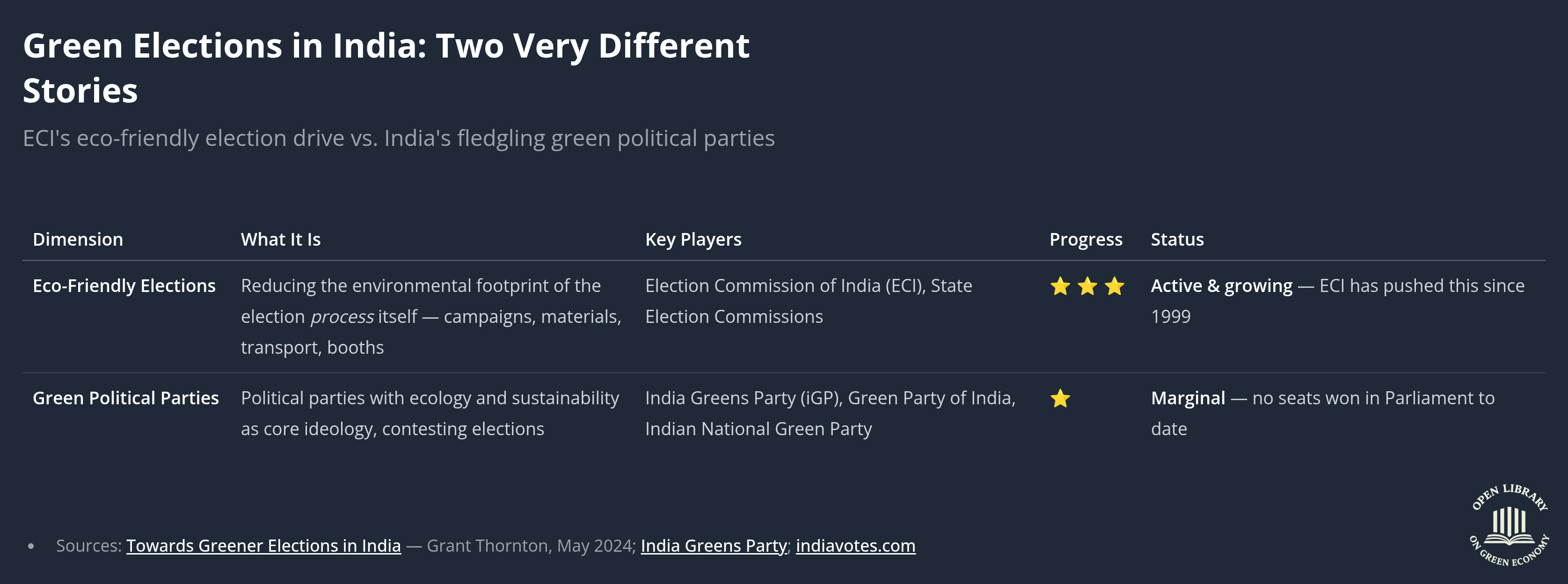
Climate change barely featured in the 2024 Indian election campaigns, despite voters and polling workers standing in 45°C heat (Reuters, June 2024). Elections were being redesigned to be more environmentally friendly at the operational level, while environmental policy remained marginal at the political level. The green administration of democracy was running ahead of the green politics of democracy.
This is not unique to India. Across 80% of global voters expressing a desire for climate action (Forbes, 2024), climate messaging consistently underperformed expectations in actual campaign content. The operational infrastructure of elections is becoming greener. The political conversation inside those elections is lagging behind.
Whether this matters depends on your theory of change. If you believe that institutional design shapes political culture over time, that people who vote in bamboo-decorated, sapling-distributing polling stations will gradually come to associate democratic participation with environmental stewardship and eventually demand that their elected representatives reflect this, then Green Elections are part of a longer arc. If you believe that only explicit political commitment drives systemic change, then Green Elections, however well-designed, are insufficient on their own.
The honest answer is probably both. Green Elections are necessary but not sufficient. They change the material culture of democracy without automatically changing its political agenda.
What Green Elections Mean for Finance, Business, and Investment
For financial institutions and ESG investors, Green Elections represent a category of public-sector sustainability innovation that operates through changing the way of working rather than spending more money. The model demonstrates that sustainability outcomes can be achieved at near-zero marginal cost when institutional incentives are correctly aligned. This challenges assumptions embedded in many ESG frameworks that sustainability requires dedicated capital allocation.
For firms with green revenue exposure, the 2024 US election demonstrated that political risk is now embedded in sustainable business valuations. Companies with higher green revenue shares experienced more negative cumulative abnormal returns around the election result, with particularly sharp effects in Democratic states (Koch & Schiereck, 2025). Political elections are, in this sense, now material financial events for green-economy businesses. Understanding how electoral processes are designed and how they are changing is becoming a legitimate dimension of political risk analysis.
For development finance institutions, the Indian model of leveraging existing supply chains (Forest Department nurseries, MGNREGA labour, Jal-Jeevan-Hariyali missions) to deliver environmental outcomes at near-zero incremental cost is instructive for green transition finance more broadly. The cheapest sustainability interventions are often those that work with existing institutional structures rather than around them.
For policy-makers in emerging economies, the Green Elections evidence offers a transferable framework for achieving multiple policy objectives simultaneously. Voter mobilisation, environmental awareness, community engagement, and institutional legitimacy are all advanced by the same set of interventions. The seven-component model described above is applicable, with contextual adaptation, to virtually any civic engagement programme.
Where This Is Headed
The trajectory since 2018 is clear. What began as borrowed waste-management practices from religious festivals has become, by 2025, a legally mandated governance standard in several Indian states. The Times of India reported in late 2025 that local governments in parts of India were required by order to conduct civic polls in accordance with green protocol standards (Times of India, 2025). International IDEA, the premier global electoral governance think tank, had by December 2024 begun evaluating global elections through a climate lens (IDEA, December 2024). The UNDP’s 2025 guide moved the conversation further still, framing climate-resilient election logistics as a distinct discipline within electoral administration.
The institutionalisation arc is accelerating. What was once bottom-up experimentation by a handful of district officers is becoming codified policy. What was once an Indian innovation is attracting attention from electoral governance organisations worldwide. International IDEA’s practitioner briefs specifically drew on Asia-Pacific lessons for a global audience (IDEA, June 2024).
The question for the next decade is not whether Green Elections will spread; they will. The more pressing questions are how deeply they will be embedded in electoral systems, how honestly their limitations will be acknowledged, and whether the green administration of elections will eventually be accompanied by the green politics that gives those elections their substantive content.
Green Elections are a small but meaningful proof of concept for something much larger: the possibility that governing institutions can be reformed from within, that sustainability and legitimacy can reinforce rather than undermine each other, and that the act of voting, the most fundamental act of democratic citizenship, can leave the world slightly better than it found it.
This post draws on fieldwork by Dr. Heera Lal Patel, alongside a wide body of supporting literature cited throughout.