
What are Market Failures?
Connection between Market Failures and Green Fiscal Policy, Fiscal Instruments to Correct Market Failures, Real World Examples, Infographics

When you walk into a shop to buy jeans, the price tag tells you only part of the story. That $50 pair might seem like a bargain compared to the $99 organic cotton alternative, but the true cost of each extends far beyond what you pay at checkout. This simple shopping decision illustrates one of the most important concepts in environmental economics: market failure.
What Are Market Failures?
Market failure occurs when markets fail to allocate resources efficiently, particularly by not accounting for the full environmental and social costs of production and consumption. In economic terms, this represents a divergence between private costs (what producers pay) and social costs (what society bears).
In the jeans example, the $50 price reflects manufacturing costs, labour, materials, transport, and profit margins. However, it excludes what economists call externalities:
Water pollution: Textile dyeing releases heavy metals, dyes, and chemicals into waterways, costing communities millions in water treatment.
Pesticide runoff: Conventional cotton uses 25% of global insecticides, contaminating soil and groundwater.
Greenhouse gas emissions: Fashion accounts for 10% of global carbon emissions, more than aviation and shipping combined.
Health impacts: Workers in textile factories face exposure to toxic chemicals, leading to respiratory diseases and cancer.
These costs don't disappear, they're simply shifted to third parties who had no say in the transaction. The organic cotton jeans at $99 appear more expensive, but their price actually internalises many of these environmental costs, making the true comparison much closer than it first appears.
Understanding Environmental Market Failures in Depth
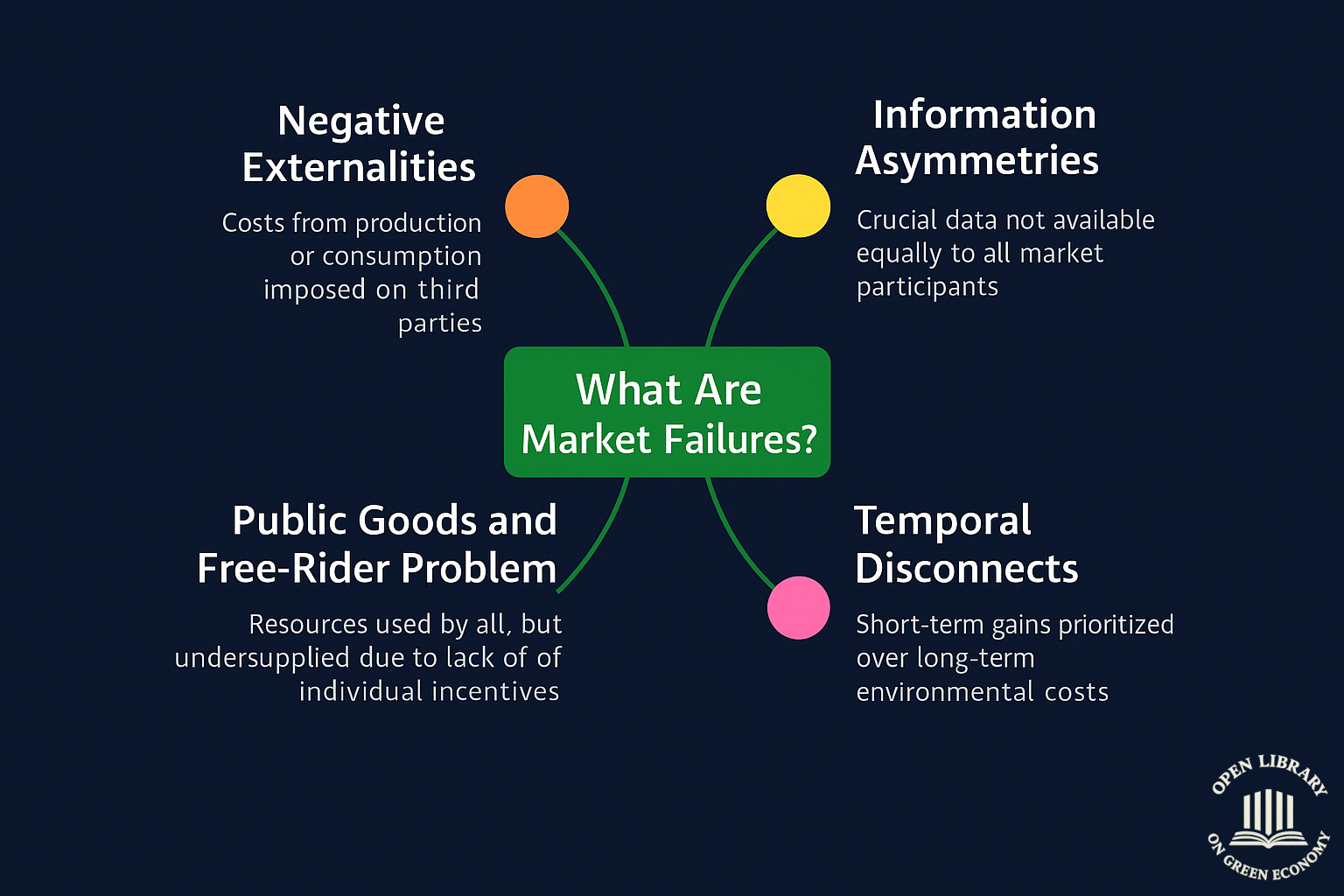
Negative Externalities
Negative externalities represent the most pervasive form of environmental market failure. They occur when the production or consumption of goods imposes costs on parties not involved in the economic transaction.
Consider the coal industry. When a power plant burns coal to generate electricity, it produces not just power but also sulphur dioxide, nitrogen oxides, particulate matter, and carbon dioxide. The power company pays for the coal, labour, and equipment, but pays nothing for using the atmosphere as a waste dump. Society bears the cost through:
Health impacts: Air pollution causes 7 million premature deaths annually, with healthcare costs exceeding $2.9 trillion globally.
Climate damage: Each tonne of CO2 imposes estimated future costs of $100-200 through climate change impacts.
Ecosystem degradation: Acid rain from coal pollution damages forests, reducing their carbon absorption capacity.
This creates a systematic bias in the economy. Coal appears cheaper than renewable energy because its hidden costs aren't reflected in market prices. Meanwhile, solar and wind power appear more expensive despite avoiding these external costs entirely.
Information Asymmetries
Markets function efficiently only when participants have access to relevant information. However, environmental impacts are often complex, distant in time and space, or deliberately obscured, creating information asymmetries that distort decision-making.
Take the smartphone industry. Consumers see a sleek device priced at $800, but remain largely unaware of its environmental footprint:
Rare earth mining: Extracting lithium, cobalt, and rare earth elements devastates landscapes and contaminates water supplies.
Manufacturing intensity: Producing one smartphone generates 70-85 kg of CO2 emissions.
Electronic waste: Only 20% of e-waste is properly recycled, with the rest leaching toxic materials into soil and groundwater.
Even when companies provide environmental information, it's often incomplete or incomparable. Without standardised metrics and mandatory disclosure, consumers cannot make truly informed choices, leading to systematic under-valuation of environmental performance.
Public Goods and the Free-Rider Problem
Environmental resources like clean air, stable climate, and biodiversity are classic public goods - non-excludable (you can't prevent others from using them) and non-rivalrous (one person's use doesn't diminish another's). This creates the free-rider problem: everyone benefits from environmental protection, but no one has sufficient individual incentive to pay for it.
Consider climate stability. Every tonne of CO2 reduced benefits everyone on Earth, but the costs fall on whoever undertakes the reduction. A company investing in energy efficiency bears the full cost but captures only a tiny fraction of the climate benefits. This leads to systematic under-investment in environmental protection, what economists call the "tragedy of the commons."
Temporal Disconnects
Short term gains, long term loss. Markets excel at coordinating immediate exchanges but struggle with costs and benefits separated by decades. Environmental problems often involve immediate economic benefits but long-term environmental costs, creating systematic bias toward short-term thinking.
The fossil fuel industry exemplifies this disconnect. Burning coal generates immediate energy and profits, but climate impacts manifest over decades. Since markets typically discount future costs at 3-7% annually, climate damages 50 years hence have minimal influence on today's investment decisions. This temporal mismatch means markets systematically under-invest in long-term environmental protection.
How Fiscal Instruments Correct Market Failures
Green fiscal policy works by adjusting price signals to reflect true social costs, transforming market failures into market solutions. Different fiscal instruments target different types of market failures through distinct mechanisms.
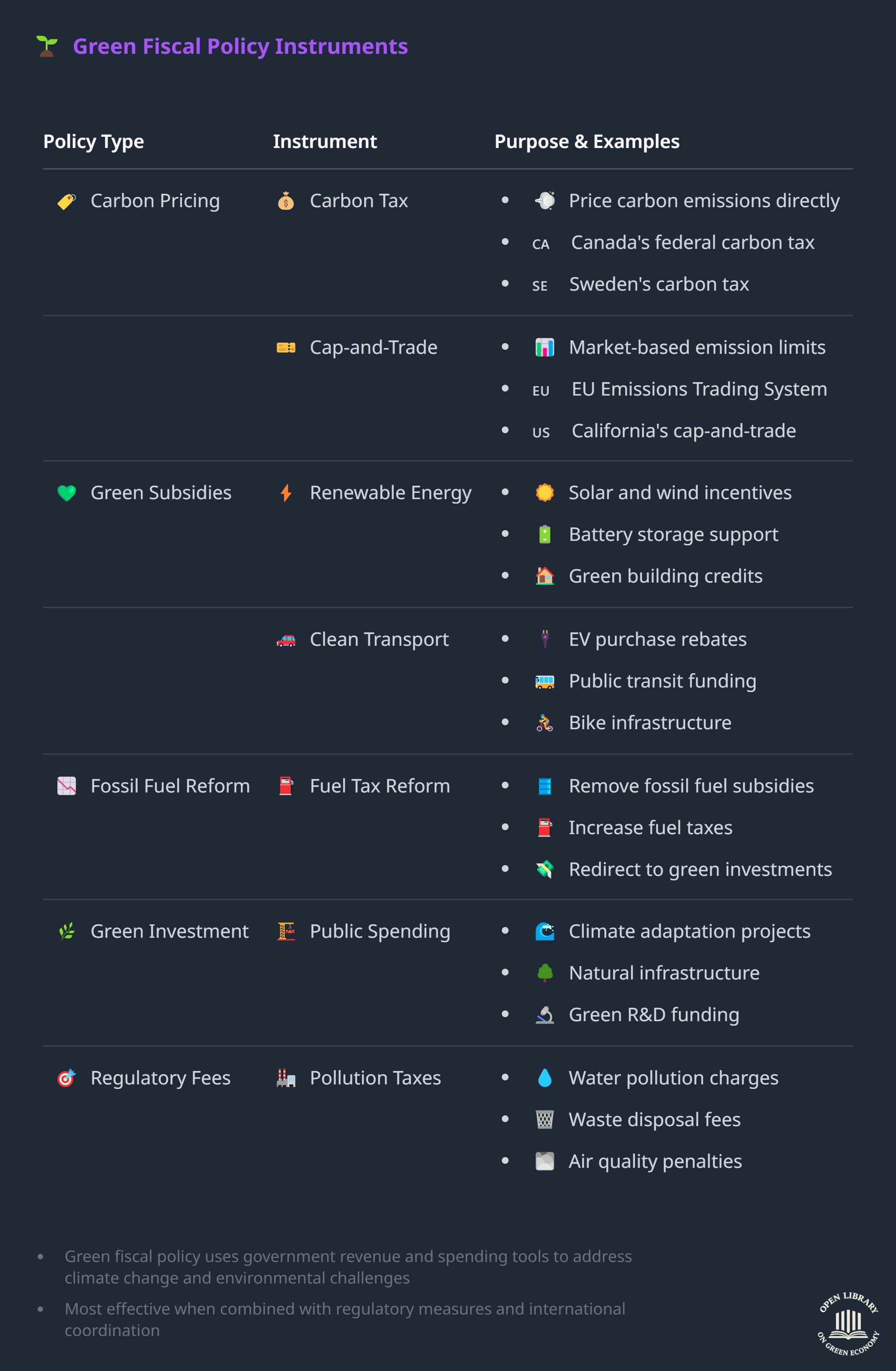
Revenue-Generating Instruments
These instruments increase the price of environmentally harmful activities, forcing producers to internalise external costs.
Carbon Taxes
Carbon taxes represent the most direct approach to correcting climate-related market failures. By putting a price on CO2 emissions, they make the hidden costs of climate change visible in market transactions.
British Columbia pioneered comprehensive carbon taxation in 2008, starting at $7 per tonne CO2 and reaching $50 per tonne by 2024. The results demonstrate how price corrections can drive behavioral change:
Fuel consumption: Gasoline use fell 7-15% compared to other provinces without carbon taxes.
Economic impact: GDP growth matched or exceeded other provinces, disproving economic harm claims.
Innovation incentive: Clean technology investment increased as carbon-intensive alternatives became more expensive.
Globally, carbon pricing revenues reached a record $104 billion in 2023, with 75 carbon pricing instruments now operating worldwide. This represents a fundamental shift in how markets price carbon, with over half the revenue funding climate and nature programmes.
Pollution Charges
Pollution charges target specific environmental problems by making polluters pay for their environmental damage. Singapore's comprehensive system illustrates this approach:
Waste disposal charges: $65 per tonne for industrial waste, encouraging companies to reduce waste generation.
Water pollution levies: Charges based on effluent quality, incentivising treatment and prevention.
Air quality fees: Emissions charges that helped Singapore maintain some of Asia's cleanest air despite dense urbanisation.
Subsidy Removal
Fossil fuel subsidies represent negative externalities in reverse, governments actually pay companies to create environmental damage. Global fossil fuel subsidies total $5.9 trillion annually, making dirty energy artificially cheap whilst penalising clean alternatives.
Indonesia's fuel subsidy reform demonstrates the transformation potential. By removing petroleum subsidies worth $20 billion annually, the government:
Levelled the playing field: Renewable energy became competitive without subsidies.
Funded green development: Saved resources financed rural electrification and clean energy programmes.
Reduced consumption: Fuel consumption fell 15% as prices reflected true costs.
Revenue-Spending Instruments
These instruments reduce the cost of environmentally beneficial activities, accelerating adoption of clean technologies and practices.
Feed-in Tariffs
Feed-in tariffs guarantee long-term contracts for renewable energy at above-market prices, correcting the market failure that under-rewards clean energy's social benefits.
Germany's Energiewende programme transformed global renewable energy markets through guaranteed prices:
Solar cost reduction: Guaranteed demand drove manufacturing scale, reducing solar costs by 80% since 2010.
Investment certainty: Long-term contracts enabled project financing that wouldn't exist in volatile energy markets.
Technology deployment: Germany went from 1% renewable electricity in 2000 to over 50% by 2024.
The programme's success sparked global replication, with over 110 countries now using feed-in tariffs to accelerate renewable deployment.
Electric Vehicle Incentives
Electric vehicle subsidies address multiple market failures simultaneously: high upfront costs, limited charging infrastructure, and consumer unfamiliarity with new technology.
Norway's comprehensive EV policy demonstrates how fiscal instruments can transform markets:
Purchase incentives: Up to $10,000 rebates plus VAT exemptions.
Usage benefits: Free parking, toll exemptions, bus lane access.
Infrastructure support: Government-funded charging network deployment.
The results are striking: EVs reached 80% of new car sales by 2023, compared to 3% globally. This market transformation occurred not through mandates but through fiscal instruments that made clean technology the economically rational choice.
Revenue-Neutral Instruments
Some fiscal instruments correct market failures without affecting government budgets, working instead through relative price changes.
Cap-and-Trade Systems
Emissions trading systems create artificial scarcity for pollution rights, forcing markets to price previously free environmental resources.
The EU Emissions Trading System, covering 40% of European emissions, demonstrates this mechanism:
Price discovery: Carbon prices rose from $7 per tonne in 2017 to $80+ per tonne in 2024 as free allowances were reduced.
Investment signals: High carbon prices made clean technologies economically attractive.
Flexibility: Companies could choose between paying for emissions or investing in reduction technologies.
Deposit-Return Systems
Bottle deposits correct the market failure where consumers don't bear the cost of waste disposal. By charging upfront deposits refunded upon return, these systems align private incentives with social costs.
Germany's comprehensive system achieves 98% return rates for bottles and cans, virtually eliminating litter whilst creating circular economy incentives.
Real-World Transformations
The Danish Waste Revolution
Denmark's waste policy transformation illustrates how fiscal instruments can revolutionise entire sectors. In the 1980s, Denmark generated 3.5 million tonnes of waste annually, with 80% going to landfills. Today, Denmark produces 4.5 million tonnes but sends just 4% to landfills.
The transformation came through fiscal instruments that corrected market failures:
Landfill taxes: Increased from $15 per tonne in 1987 to $85 per tonne by 2024.
Incineration charges: Energy-from-waste facilities pay fees, encouraging waste reduction over treatment.
Extended producer responsibility: Manufacturers pay for entire product lifecycle, incentivising design for recyclability.
The results demonstrate how price corrections drive systematic change:
Waste reduction: Per capita waste generation fell 30% despite economic growth.
Recycling rates: Material recovery increased from 20% to 60% .
Innovation: Danish companies became global leaders in waste-to-energy and recycling technologies.
Sweden's Carbon Tax Success Story
Sweden introduced the world's highest carbon tax in 1991 at $26 per tonne CO2, rising to $130 per tonne by 2024. Critics predicted economic disaster, but results demonstrate how correcting market failures can drive prosperity:
Decoupling: GDP grew 60% whilst emissions fell 35% between 1990-2020.
District heating: Carbon taxes made fossil fuel heating expensive, driving massive expansion of efficient district heating networks.
Industrial transformation: Steel companies developed hydrogen-based production, paper mills invested in biofuels, and energy companies switched to renewables.
The Swedish experience proves that when markets price carbon correctly, they drive innovation and efficiency improvements that benefit both economy and environment.
Advanced Fiscal Design

Revenue Recycling
Carbon taxes face political opposition because they're visible and impose immediate costs. However, revenue recycling can build support by ensuring taxpayers benefit from environmental improvements.
Canada's federal carbon tax demonstrates this approach. Starting at $15 per tonne CO2 in 2018 and rising to $50 per tonne by 2024, the tax returns all revenues to households as rebates. Most families receive more in rebates than they pay in carbon taxes, with rural areas receiving 20% top-ups to account for higher energy needs.
The system creates political durability by:
Progressive distribution: Lower-income households benefit most since they produce fewer emissions.
Visible benefits: Quarterly rebate cheques demonstrate government commitment to revenue recycling.
Regional fairness: Higher rebates in provinces with greater carbon intensity or rural populations.
Border Carbon Adjustments
Companies worry that carbon pricing puts them at competitive disadvantage against imports from countries without carbon costs. Border carbon adjustments address this market failure by extending carbon pricing to imports.
The EU's Carbon Border Adjustment Mechanism (CBAM) enters full force in 2026, requiring importers to pay for carbon content in cement, steel, aluminium, fertilisers, and electricity. The system initially covers sectors representing 55% of EU industrial emissions.
CBAM works by:
Emissions accounting: Importers must report embedded carbon in their products.
Certificate purchase: They buy CBAM certificates corresponding to emissions that would have faced EU carbon prices.
Credit mechanism: Credits are available for carbon taxes paid in the country of origin, avoiding double taxation.
This creates a level playing field where both domestic and foreign producers face equivalent carbon costs, eliminating the competitive disadvantage of climate action.
Dynamic Pricing
Static fiscal instruments can become outdated as technology and circumstances change. Dynamic mechanisms adjust automatically to maintain effectiveness.
California's cap-and-trade system includes a price corridor that maintains carbon prices within target ranges:
Price floor: Minimum auction price starts at $15 per tonne and rises 5% annually plus inflation.
Price ceiling: Maximum price triggers additional allowance release if carbon costs spike.
Market stability: Reserves adjust supply based on price levels, preventing excessive volatility.
This design maintains investment certainty whilst preventing economic disruption from carbon price spikes.
The Transformation Effect
When fiscal instruments successfully correct market failures, they create transformation effects that extend far beyond environmental improvements.
Innovation Incentives
Properly designed fiscal instruments create innovation incentives that drive technological advancement. When polluting activities become expensive, companies invest in cleaner alternatives. When clean technologies receive support, they achieve scale and cost reduction.
The solar industry exemplifies this dynamic. Feed-in tariffs in Germany, Japan, and other countries created guaranteed markets for solar panels, driving massive investment in manufacturing and R&D. The result: solar costs fell 90% between 2009-2024, making it the cheapest electricity source in many markets.
First-Mover Advantages
Countries that implement green fiscal policies early often capture first-mover advantages in emerging clean technology markets. Danish wind companies dominate global markets because early wind energy support created world-leading expertise. Chinese solar manufacturers achieved global dominance partly because domestic policies created large home markets.
Co-Benefits Realisation
Environmental fiscal instruments often deliver co-benefits that multiply their value. Air pollution taxes reduce both climate emissions and local air quality problems. Energy efficiency incentives cut both environmental impact and energy costs. These co-benefits often exceed the primary environmental benefits, making green fiscal policy economically attractive even without considering environmental gains.
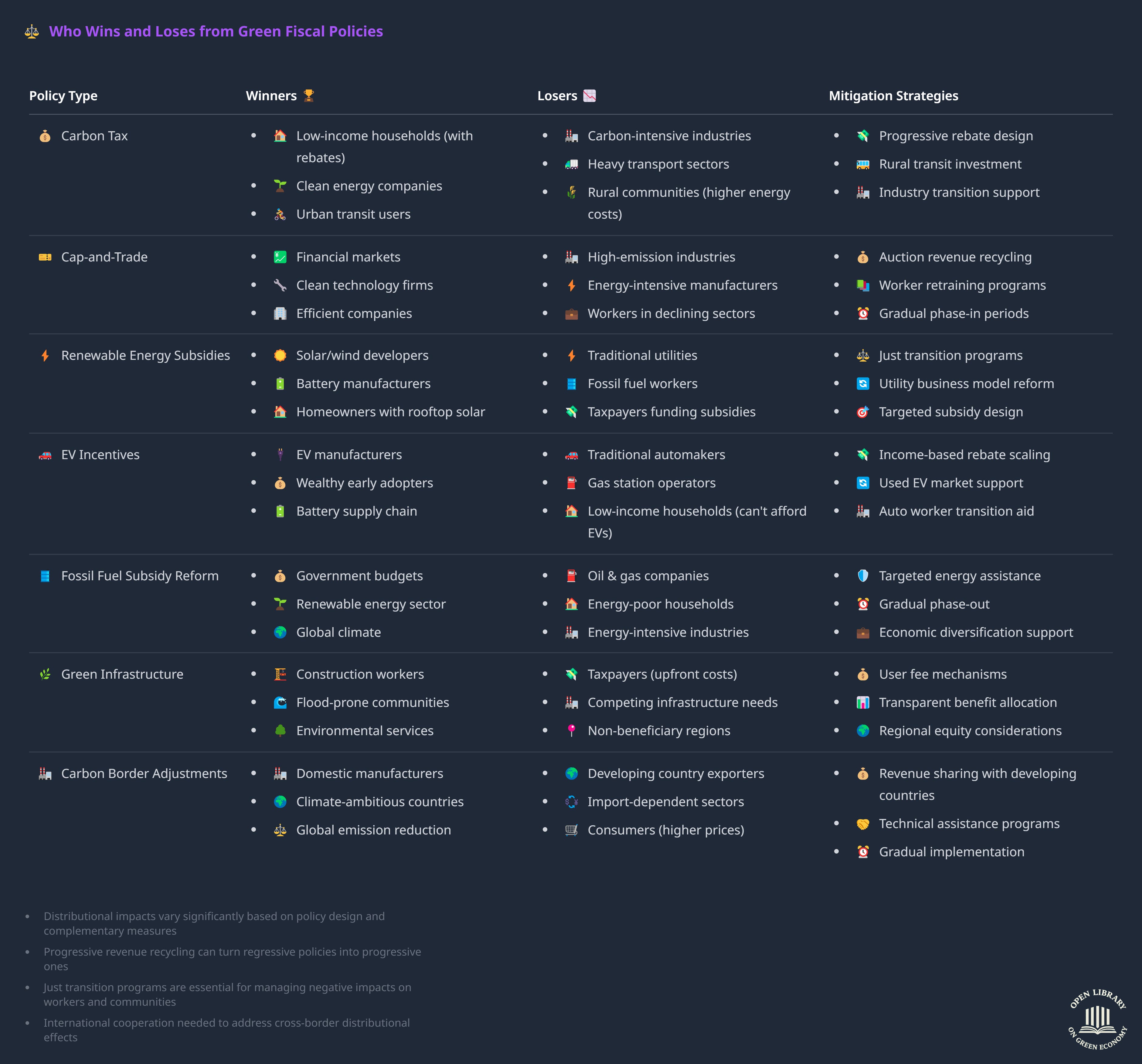
Ending Note
Market failures in environmental markets are not abstract economic concepts, they represent real costs borne by real people. Every tonne of CO2 emitted today will impose costs estimated at $100-200 on future generations. Every piece of plastic waste in the ocean costs marine ecosystems and human health. Every hour of coal plant operation imposes health costs on surrounding communities.
Green fiscal policy offers a systematic approach to correcting these failures, aligning private incentives with social benefits. When markets price environmental costs correctly, they become powerful allies in addressing climate change and environmental degradation rather than obstacles.
The transformation is already underway. With 75 carbon pricing instruments operating globally and revenues exceeding $100 billion annually, fiscal instruments are moving from policy experiments to economic mainstream. Success stories from British Columbia to Sweden to Denmark demonstrate that correcting market failures through fiscal policy can drive prosperity whilst protecting the environment.
The question isn't whether we can afford to implement green fiscal policy, it's whether we can afford not to. The hidden costs are already being paid; the only question is who pays them and when. Green fiscal policy simply makes these costs visible so markets can respond efficiently, harnessing the power of price signals to drive the clean energy transition our planet urgently needs.