
What are the Behavioral Barriers to the Green Economy?
Introduction to Series on Behavioral Barriers, Why Green Policy Often Underperforms, What Behavioral Research Reveals, its Implications and What This Series Will Examine

The green economy has rarely lacked ambition. Over the past three decades, governments, multilateral institutions, and private actors have produced a substantial body of policy: carbon pricing in dozens of jurisdictions, renewable portfolio standards, energy efficiency mandates, sustainable finance disclosure regulations, and household-level subsidies for clean technologies. The architecture of climate and sustainability policy has expanded considerably, with new instruments, institutions, and regulatory frameworks emerging across multiple sectors and regions.
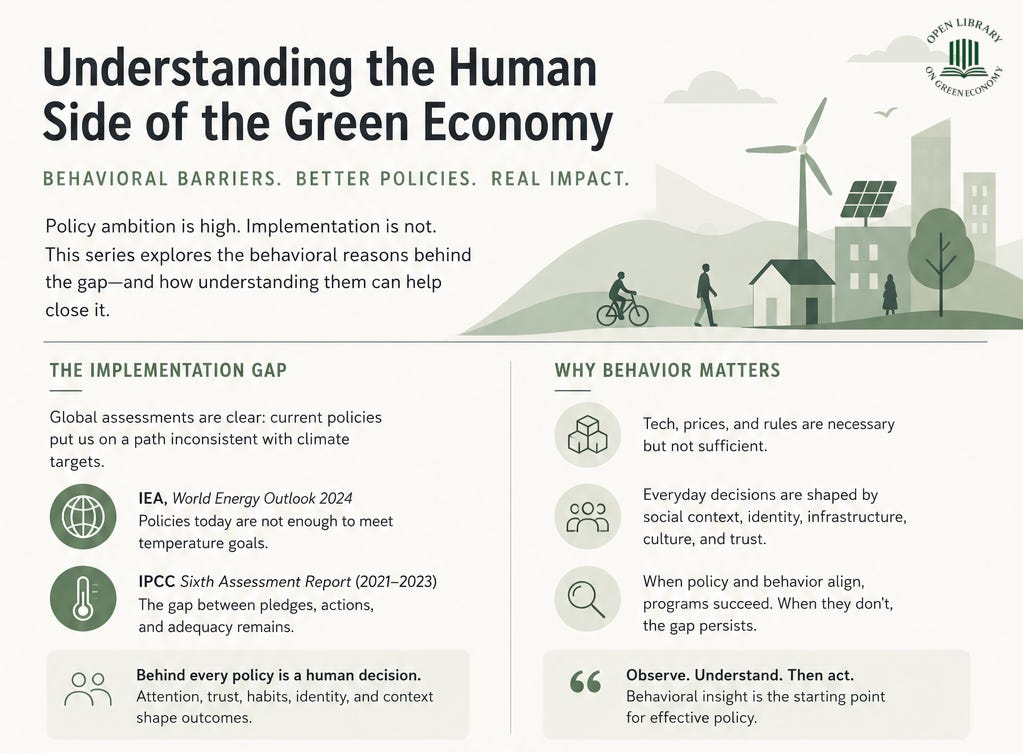
And yet the implementation gap remains stubbornly visible. The International Energy Agency’s World Energy Outlook 2024 documented that current policies place the world on a trajectory inconsistent with the temperature stabilization targets that successive global climate agreements have set. The IPCC’s Sixth Assessment Report, released between 2021 and 2023, reached a related conclusion: the gap between pledges and actions, and between actions and adequacy, has narrowed but not closed. Among the explanations for this gap, one is consistently overlooked in mainstream policy debate. It is behavioral.
This series, “Behavioral Barriers to the Green Economy,” examines what that behavioral dimension actually contains, how it interacts with structural and economic conditions, and why understanding it matters for citizens, institutions, and policymakers working on the green transition. Each monthly installment will examine one specific domain of green economy decision-making, beginning with household solar adoption and moving through dietary behavior, transport choices, sustainable consumption, water use, waste management, and the behavior of the institutions tasked with delivering green policy. This opening installment introduces the lens, the commitments, and the recurring question that will shape the series.
The Implementation Gap
Behind every successful green policy, and behind every disappointing one, sits a chain of decisions made by households, firms, and public institutions. A subsidy for rooftop solar must be noticed, understood, trusted, and acted upon. An efficiency standard must be enforced, and the appliances it covers must be purchased. A carbon price must change behavior at the margin where actors choose between cleaner and dirtier options. None of these decisions are mechanical. All of them are mediated by attention, trust, habit, identity, social context, and the circumstances of daily life.
When these mediations are well-aligned with policy intent, programs succeed. When they are misaligned, programs underperform, sometimes substantially. The implementation gap is rarely a single failure of design or financing. More often it is a series of smaller failures of fit, each of which becomes legible only when one looks closely at the actor whose behavior the policy hoped to change.
Research on this gap has accumulated steadily. The World Bank’s World Development Report 2015: Mind, Society, and Behavior synthesized two decades of behavioral research and concluded that policy designed without attention to how people actually think and decide is unlikely to achieve its objectives. The IPCC Working Group III contribution to the Sixth Assessment Report (2022) dedicated substantial attention to demand-side mitigation, drawing on behavioral and social-science evidence to argue that lifestyle, choice, and behavioral change carry significant and underutilized mitigation potential. These are no longer minority views. They are mainstream conclusions of mainstream institutions.
Why Behavior Matters
Green economy debates have often been organized around two recurring framings. The first is techno-economic: the right technologies and the right prices will drive the transition. The second is regulatory: the right rules, well enforced, will produce the necessary outcomes. Both framings are necessary, and both have produced real progress. Each is also incomplete on its own. A growing body of social-science research, represented in journals such as Energy Research & Social Science and related literature, has argued for some years that the green transition is also sociotechnical and behavioral, shaped by everyday practices, cultural meanings, institutional habits, and the conditions of daily life (Cherp et al., 2018).
The reason these framings are incomplete is that the green transition is not delivered by technology or regulation alone. It is delivered through the everyday decisions of millions of actors whose responses to technology and regulation are shaped by factors that standard models do not always capture. A household choosing whether to install a solar water heater is responding to price, but also to the trustworthiness of the installer who knocked on the door, the visibility of panels on neighbors’ roofs, the perceived quality of the housing stock, the implicit time horizon over which the family expects to remain in the home, and the meaning that a solar panel carries in the local culture. A small business owner choosing whether to upgrade to efficient lighting is responding to payback period, but also to the cognitive load of an unfamiliar purchase, the quality of available information, and the social norms of the trade.
These factors are not noise around a rational signal. They are the decision itself. Behavioral research, drawing on psychology, sociology, behavioral economics, and anthropology, has spent several decades documenting the systematic patterns by which they shape outcomes. The findings are now substantial enough to take seriously, and the cost of ignoring them in green policy has become high enough that doing so is no longer defensible practice.
What Behavioral Economics Offers, and What It Does Not
The behavioral toolkit, as commonly applied to green economy questions, includes a recognizable set of techniques. Default settings can substantially shift outcomes, as experience with green energy tariff defaults in several European jurisdictions has demonstrated. Framing matters: a savings reframe of the same financial information can produce different decisions. Social comparison feedback was evaluated rigorously by Hunt Allcott in a 2011 paper in the Journal of Public Economics, which analyzed Opower’s Home Energy Report letters across roughly 600,000 treatment and control households in the United States. The reports compared each household’s electricity use to that of similar neighbors, and the average program reduced electricity consumption by about 2 percent, an effect comparable to that of a short-run electricity price increase. Information disclosure on appliance efficiency labels has produced measurable effects on purchase decisions in multiple jurisdictions.
These tools are real, and their successes are documented. The behavioral approach has earned its place in the green economy policy mix.
But the toolkit has limits, and an honest reckoning with those limits has begun within the discipline itself. In a 2023 paper in Behavioral and Brain Sciences, Nick Chater and George Loewenstein argued that behavioral public policy has leaned too heavily on what they call the “i-frame” (interventions aimed at the individual), at the expense of the “s-frame” (the structures and systems within which choices are made). The paper has been contested, as the journal’s format invites, but the underlying observation has resonated widely among researchers. Many of the most consequential green decisions are shaped by the building stock a household lives in, the infrastructure the city has built, the credit markets a small firm can access, the tenure security a farmer enjoys, and the trust networks through which information about technologies actually travels.
This is an argument for using behavioral economics well. The discipline’s most enduring contribution to green economy practice may not be its growing toolkit of interventions but its insistence that we observe what actors actually do, and understand why, before we propose to change them.
Indian and Global South Relevance
Most of the foundational behavioral research that informs green economy policy was developed in what the anthropologist Joseph Henrich and colleagues, in a 2010 paper in Behavioral and Brain Sciences, called WEIRD contexts: Western, Educated, Industrialized, Rich, and Democratic. The findings of this research are not always universal. When transported to India, Sub-Saharan Africa, Southeast Asia, or parts of Latin America, some interventions weaken, others strengthen, and a few reverse direction entirely. Trust dynamics differ. Household structures differ. Gender norms shape who decides and who uses. Informal economies operate by their own rules. Infrastructure is patchier and more variable. The “household” of the Anglo-American behavioral textbook is one household among many.
India has been a particularly rich site for adapted behavioral research over the past decade. Randomized evaluations conducted by J-PAL South Asia have produced rigorous evidence on environmental behavior in domains ranging from clean cookstove adoption to water and sanitation. Organizations such as SELCO Foundation, founded in Karnataka in 1995, have demonstrated that distributed solar models designed around the actual constraints of low-income rural households outperform centralized approaches that assume an abstract user. Indian state institutions have developed their own behavioral capacity, with several ministries and state governments running behavioral pilots on energy use, waste management, and public service delivery.
This series will draw on Indian evidence and Global South contexts as core material rather than as illustrations of findings derived elsewhere.
A Recurring Question
A series benefits from a recurring intellectual move that connects its installments. The question this series will ask of every subject is the following: what is the actor actually doing, and why does the standard policy frame miss it?
This question contains three commitments. First, that the actor, whether a household, a firm, or an institution, is doing something coherent before the policy arrives, even when the behavior looks inefficient or irrational from outside. Second, understanding what they are doing requires looking at the full context (economic, social, cultural, infrastructural, and institutional) within which the behavior makes sense. Third, that policy frames developed in one context do not always travel, and that the work of seeing clearly is local before it is general.
The question does not commit the series to any particular intervention. It commits it to a particular kind of attention.
What This Series Will Examine
The installments planned for the coming months will address one behavioral domain at a time. The order is provisional and may shift as research and current events warrant.
Household solar and energy decisions. Why do similar households in similar conditions make different choices about rooftop solar, solar water heaters, and energy-efficient appliances? What does the evidence show about the role of trust networks, housing market signals, and local installer ecosystems?
Dietary and food behavior. How does the green transition intersect with what households eat? What does behavioral research show about the limits of information-based interventions on dietary change, and what alternatives are emerging?
Transport choices. Why do public transport investments succeed in some cities and fail in others, even when prices and routes appear comparable? What does the evidence say about habit, identity, and the symbolic meaning of transport modes?
Sustainable consumption. What shapes the gap between intentions to buy or use less and the patterns of consumption that actually unfold in households? How do branding, convenience, social context, and access constraints interact with the sustainability claims attached to consumer products?
Water use and conservation. How does household water behavior respond to pricing, information, and social comparison, and why do these responses differ sharply across regions?
Waste, recycling, and circular behavior. What does the evidence show about the gap between recycling intentions and recycling outcomes, and what role do infrastructure and convention play?
Institutional and bureaucratic behavior. Why do environment ministries default to particular policy instruments? What behavioral patterns shape how green policy is designed, implemented, and evaluated?
The series will also occasionally step back to examine cross-cutting themes: gender and behavior in green economy decisions, the replication crisis in behavioral economics and what it means for green policy, and the relationship between behavioral interventions and structural reform.
What This Series Will Not Do
This series will not advocate for any particular political position or policy package. It will examine evidence, including evidence that complicates positions the author is sympathetic to.
This series will not present nudges as a magic solution. The behavioral toolkit is one input among many. Where it helps, the series will say so. Where it does not, the series will say that as well.
This series will not treat behavioral findings as universal. Where research has been conducted primarily in WEIRD contexts and may not transfer, the series will note this limitation. Where Indian and Global South evidence diverges from the dominant findings, the divergence will be foregrounded, not glossed.
This series will not substitute behavioral analysis for structural analysis. The recognition that behavior matters does not displace the equally important recognition that behavior is shaped by structures, and that some green economy problems require structural rather than behavioral solutions.
Implications for Citizens, Institutions, and Policy
A series like this is intended to be useful not only to readers professionally engaged with green economy questions but also to citizens and students who want to understand the field more carefully.
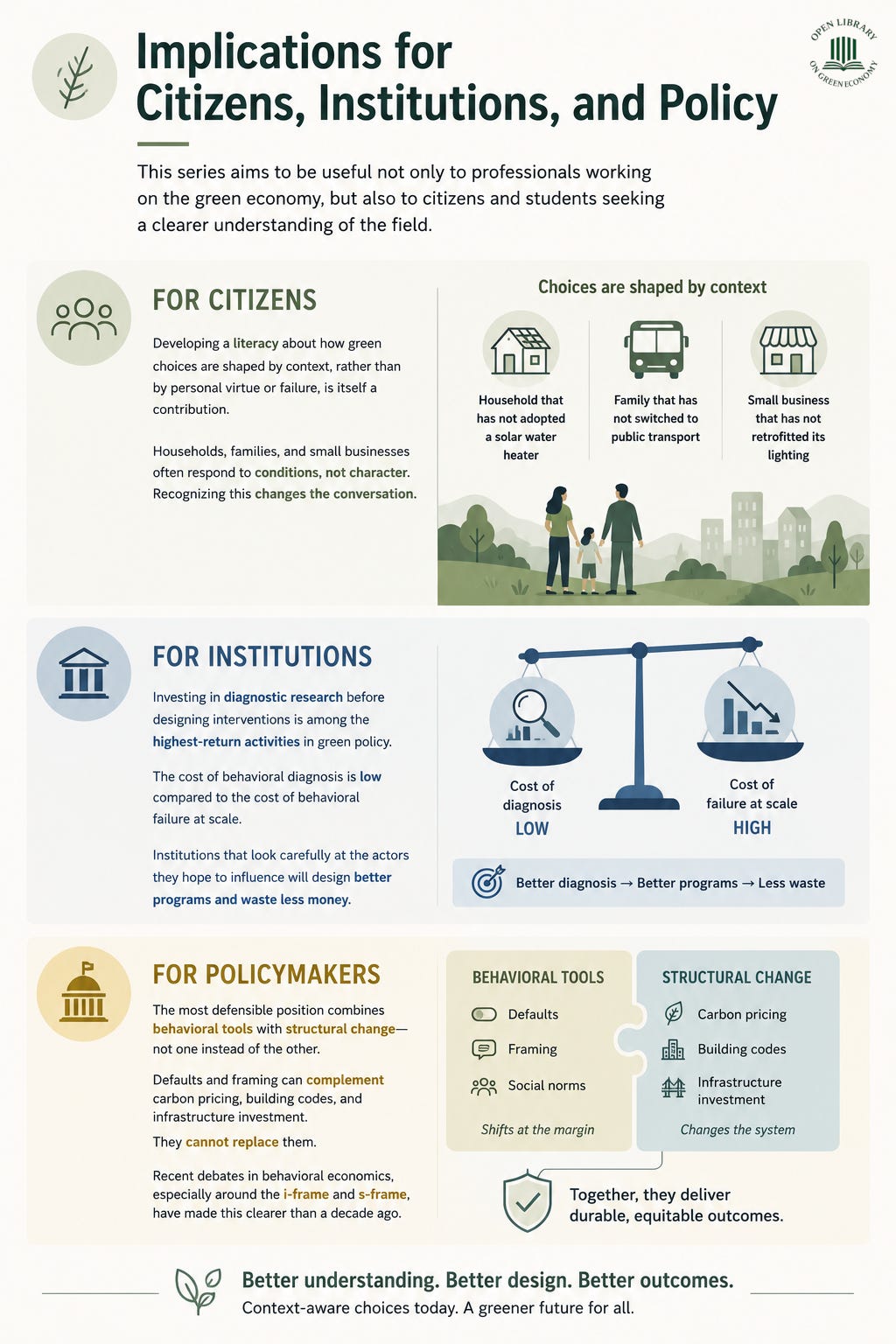
For citizens: Developing a literacy about how green choices are shaped by context, rather than by personal virtue or failure, is itself a contribution. The household that has not yet adopted a solar water heater, the family that has not switched to public transport, the small business that has not retrofitted its lighting, are usually responding to conditions, not to character. Recognizing this changes the conversation.
For institutions: Investing in diagnostic research before designing interventions is among the highest-return activities available to any organization working on green policy. The cost of behavioral diagnosis is low compared to the cost of behavioral failure at scale. Institutions that build the habit of looking carefully at the actors whose behavior they hope to influence will design better programs and waste less money.
For policymakers: The most defensible position is one that combines behavioral tools with structural change rather than substituting one for the other. Defaults and framing can complement carbon pricing, building codes, and infrastructure investment. They cannot replace them. The recent debates within behavioral economics itself, particularly around the i-frame and s-frame, have made this clearer than it was a decade ago.
Closing Note
The green economy is not a technology problem alone, nor a regulatory problem alone, nor a behavior problem alone. It is the meeting point of all three, complicated by culture, geography, and history. The series this introduction opens will spend the coming months examining one specific behavior at a time, asking what the actor is actually doing and why the standard frame misses it, drawing on Indian and Global South evidence wherever possible, and resisting the temptation to recommend before understanding.
If the series succeeds, readers will finish each installment knowing more about one specific corner of green economy decision-making than they did before, and knowing the questions to ask of the next corner. That is the modest but real ambition.
The next installment will examine household solar adoption, beginning with cases from Turkey and India that complicate the standard story.
SDG Alignment
This series contributes primarily to SDG 13 (Climate Action), SDG 7 (Affordable and Clean Energy), SDG 11 (Sustainable Cities and Communities), and SDG 12 (Responsible Consumption and Production), with secondary contributions to SDG 5 (Gender Equality) and SDG 4 (Quality Education) where relevant to specific installments.
References
Allcott, H. (2011). Social norms and energy conservation. Journal of Public Economics, 95(9-10), 1082-1095. https://doi.org/10.1016/j.jpubeco.2011.03.003
Chater N, Loewenstein G. The i-frame and the s-frame: How focusing on individual-level solutions has led behavioral public policy astray. Behavioral and Brain Sciences. 2023;46:e147. doi:10.1017/S0140525X22002023
Cherp, A., Vinichenko, V., Jewell, J., Brutschin, E., & Sovacool, B. (2018). Integrating techno-economic, socio-technical and political perspectives on national energy transitions: A meta-theoretical framework. Energy research & social science, 37, 175-190. https://doi.org/10.1016/j.erss.2017.09.015
Henrich, J., Heine, S. J., & Norenzayan, A. (2010). The weirdest people in the world?. Behavioral and brain sciences, 33(2-3), 61-83.
International Energy Agency (IEA). (2024). World Energy Outlook 2024. https://www.iea.org/reports/world-energy-outlook-2024
Intergovernmental Panel on Climate Change (IPCC). (2022). Sixth Assessment Report, Working Group III: Mitigation of Climate Change. https://www.ipcc.ch/report/ar6/wg3/
J-PAL South Asia. (n.d.). Environment, Energy, and Climate Change. Abdul Latif Jameel Poverty Action Lab. https://www.povertyactionlab.org/south-asia
SELCO Foundation. (n.d.). About Us.
https://selcofoundation.org/
World Bank. (2015). World Development Report 2015: Mind, Society, and Behavior. https://www.worldbank.org/en/publication/wdr2015
 | A guest post by
|