
What is Green Infrastructure?
Definition & Principles, Types of Green Infrastructure, Economic & Environmental Impact, Controversies & Gaps, Evaluating and Adapting in Urban Contexts

Cities around the world are facing two big pressures: fast urban growth and climate change. Problems like higher temperatures, sudden floods, air pollution and the loss of different kinds of animals and plants have become common challenges.In these difficult situations, green infrastructure has become an effective solution that combines ecological functions with a better quality of urban life.
Different from traditional grey infrastructure (such as concrete roads, drainage pipes and man-made buildings), green infrastructure uses natural systems and nature-based methods to bring many benefits to the environment, society and economy.This article explains the basic definition, main parts, real-life uses and related discussions of green infrastructure. At the same time, it explores how it helps build cities that are more able to deal with risks and develop in a sustainable way.
Definition and Core Principles
The European Commission describes green infrastructure (GI) as a carefully planned network of natural and semi-natural areas. Its main goal is to provide various ecosystem services that are essential for human society (European Commission, 2013, p.2).GI follows three key principles: connectivity, multifunctionality, and adaptability. These principles work by combining natural processes with spatial planning and regional development (European Commission, 2013, p.2).
Connectivity connects separate natural areas, helping wildlife move around and reducing the fragmentation of ecosystems (European Commission, 2013, p.4).
Multifunctionality means that features like green roofs can do several things at once: they cut greenhouse gas emissions, hold rainwater, and increase biodiversity in cities (European Commission, 2013, p.5).
Adaptability means that GI such as floodplain forests can better resist climate change at a lower cost than rigid “grey infrastructure” (like concrete dams or walls). This helps balance environmental protection and sustainable regional development (European Commission, 2013, p.4).
Functional Components of Urban Green Infrastructure
Green infrastructure (GI) means the connected system of natural and man-made features in cities. It is designed to help cities deal with risks better, such as reducing flood dangers, easing the urban heat island (UHI) effect and making cities more livable (Ukonze et al., 2025, p.2; Staddon et al., 2018; Benedict and McMahon, 2002). Its parts can be adjusted to fit different local conditions, providing various ecological, social and economic values. Besides protecting the environment, it also supports people’s well-being and the long-term sustainable development of cities.
Urban Parks and Green Spaces
Public parks, community gardens and urban forests are basic parts of GI. They combine environmental functions with social needs. For the environment, they reduce the UHI effect through the “green island effect”. A research in London showed that the cooling range depends on the area covered by tree leaves, and the cooling degree is related to grassland area. Larger green spaces can cool the environment more effectively (in a non-linear, faster-growing way) (Yu et al., 2020, pp.4-5; Chang et al., 2007). This means expanding green spaces in a planned way can bring much greater climate benefits.
Socially, they meet city dwellers’ psychological and entertainment needs (Chiesura, 2004, p.129). Their beautiful scenery also attracts tourists and increases income (Chiesura, 2004, p.130). London’s Hyde Park, which covers 142 hectares, is a good example of this dual role. It lowers the local temperature by 2–3°C in summer and serves as an important cultural place.
Green Roofs and Walls
Buildings with plants on their roofs or walls are highly effective GI parts for crowded cities. They work by keeping heat in, providing shade and cooling through plant water evaporation (Getter et al., 2011, p.3548). A 2023 study from the University of Sheffield found that they can save 10–15% of energy in winter and reduce cooling needs by 20–25% in summer.
AI models prove their good thermal performance (Mihalakakou et al., 2023, p.8). Also, their design can be adjusted easily—thicker soil improves heat insulation, and different layers help transfer heat better. This makes them economical to add to old buildings (Mihalakakou et al., 2023, p.7).
Bioretention Systems
Rain gardens, bioswales (vegetated drainage channels) and permeable pavements help manage rainwater and pollution. Bioswales along highways in Maryland can absorb 600–1600 mm of rain per hour. They catch 95–100% of rainfall and reduce surface runoff by 87–96% (Eshleman et al., 2025, p.2).
They also remove more than 50% of phosphorus, meeting the goals of the Ministry of Ecology and Environment (MEP; Eshleman et al., 2025, p.3). This is in line with the U.S. Environmental Protection Agency (EPA)’s work to improve urban water use efficiency (U.S. Environmental Protection Agency, 2018, p.6).
Wetlands and Riparian Zones
Restored wetlands and riparian areas (land near rivers) reduce nutrient runoff, flood risks and soil erosion (Englund et al., 2021, p.2), and help soil store more carbon (Englund et al., 2021, p.3). The restoration project of the Spree River in Berlin improved water quality by 30% and increased fish numbers by 40%.
Plants in riparian areas help regulate the urban water cycle (Kuhlemann et al., 2022, p.2), connecting land and water ecosystems.
Urban Forestry
Street trees and the area they cover form the “green backbone” of GI. Each mature tree can absorb about 22 kg of carbon dioxide (CO₂) every year and filter fine particles (PM2.5) (World Economic Forum, 2024). Urban trees in the United States remove 711,000 tons of pollutants annually (Nowak et al., 2006, p.115).
The area covered by tree canopies is key to these benefits. In Davis, California, street trees cover 5% of the land and 14% of the streets. They reduce the UHI effect and make pavements last longer (Maco & McPherson, 2002, pp.270, 273). Since street trees make up less than 10% of America’s urban forests, expanding mixed vegetation (grass, shrubs and trees) is important to help cities cope with droughts (Kuhlemann et al., 2022, p.1).
Economic and Environmental Impacts
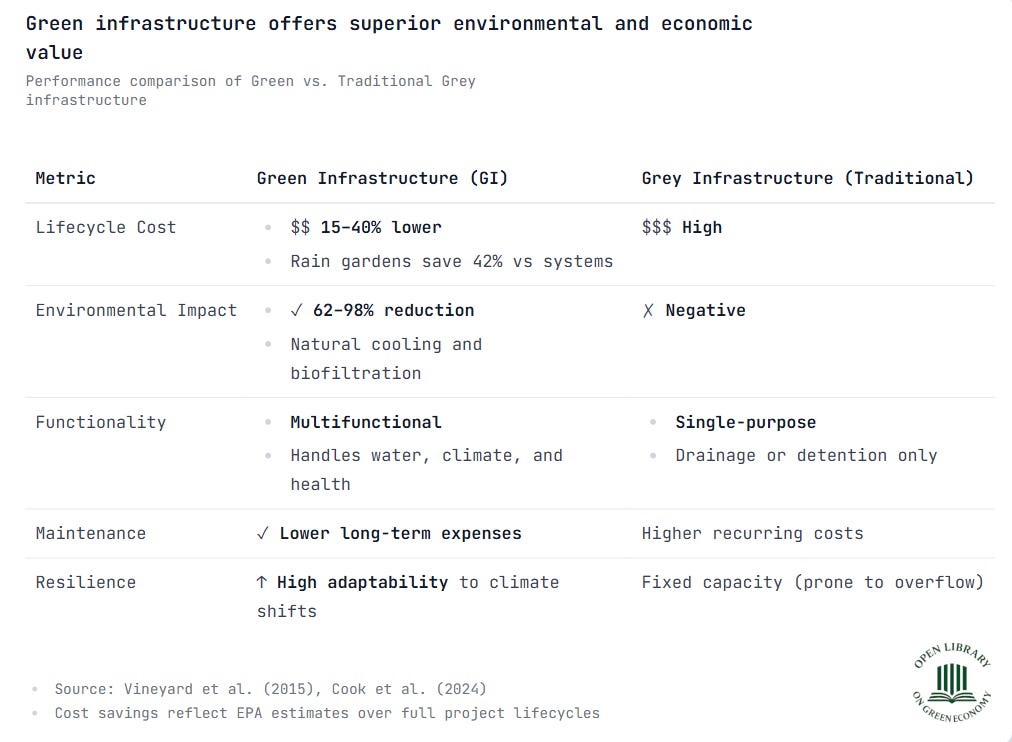
Green infrastructure (GI) provides three key types of value: environmental, economic and social. This makes it a cost-saving choice compared with grey infrastructure. Life cycle assessments show that rain gardens reduce costs by 42% and environmental harm by 62–98% when compared with traditional systems (Vineyard et al., 2015, p. 1342). The EPA also estimates that GI costs 15–40% less over its whole service life (Vineyard et al., 2015, p. 1344).
Unlike grey infrastructure, which only serves one purpose, GI can deal with rainwater management, risk resistance and public health all at the same time (Cook et al., 2024, p. 1). This is a very important advantage for areas with fast urban growth (Qoraney et al., 2024, p. 123).
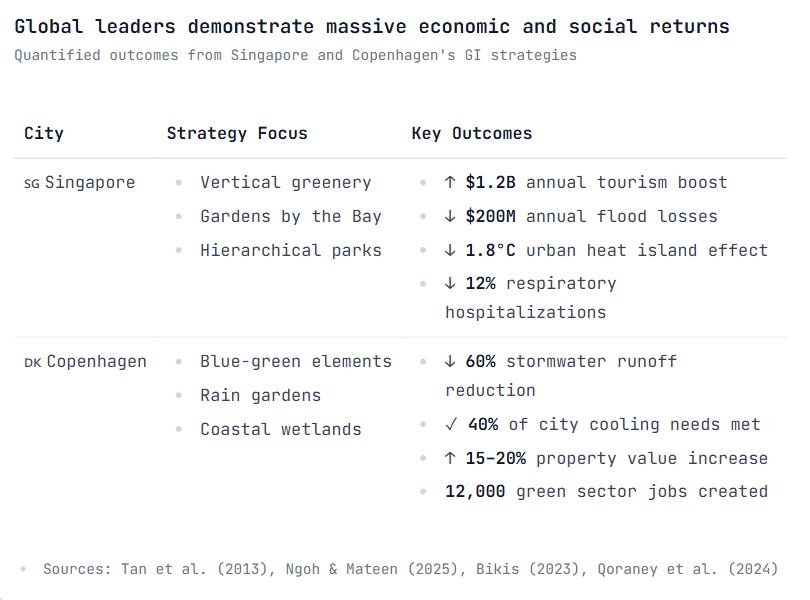
Singapore’s “City in a Garden” project is a good example of how to use GI in a city with little land. A 50-year greening plan (started in 1963) included vertical greenery, rooftop gardens and Gardens by the Bay, which has 1.5 million plants (Tan et al., 2013, p. 25).
The results are impressive: the urban heat island effect has dropped by 1.8°C, it saves $200 million every year on flood control, brings in $1.2 billion from tourism, and reduces hospital admissions for respiratory diseases by 12% (Ngoh & Mateen, 2025, p. 33; Bikis, 2023, p. 3). Despite its high population density, Singapore’s layered park system kept 0.75 hectares of green space per 1,000 residents (Tan et al., 2013, p. 26), proving that GI can solve the problem of limited land.
Copenhagen’s blue-green network, which includes bike lanes and rain gardens, has cut stormwater runoff by 60% and meets 40% of the city’s cooling needs. It also creates 12,000 green jobs and increases property values by 15–20% (City of Copenhagen, 2020, p. 6; Qoraney et al., 2024, p. 123). By linking GI to local priorities—such as rainwater management and active transport—the city has built a resilient and lively system.
These cases show that GI is not just a kind of infrastructure, but also a tool for city management. Designing GI in a coordinated way to get the most benefits (Cook et al., 2024, p. 7) offers a useful model: balancing efficiency, environmental protection and people’s well-being to build sustainable cities.
Controversies, Opposing Views, and Unaddressed Gaps
Although green infrastructure (GI) has clear benefits for sustainability (Chau et al., 2025, p. 1), it is strongly criticized because of trade-offs, lack of resources and unfairness. One main criticism is about land supply and opportunity cost: in crowded cities like Hong Kong, using land for green spaces conflicts with the need for housing and economic development (Chau et al., 2025, p. 7). This shows problems in government management. For example, Melbourne has a “governance deficit”, which leads to uncoordinated policies that focus more on short-term development than GI. As a result, low-income areas—where land is already in short supply—do not get enough GI support (Chau et al., 2025, p. 15).
The second problem is maintenance and long-term use. GI needs regular care (such as trimming plants), which many cities cannot afford (Chau et al., 2025, p. 3). Its long-term advantages (like reducing heat) are hardly measured in business plans, so investing in GI is seen as risky (Chau et al., 2025, p. 4). If GI is not well maintained, it may become dangerous (for example, blocked drains). This makes poor cities doubt whether they can afford GI. Only special systems (such as Melbourne’s matched-funding grants) can solve part of the problem (Chau et al., 2025, p. 16).
Finally, unfair gaps make inequality worse. American Forests (2024) found that low-income areas have 35% less tree cover. This means these areas are more exposed to heat, which is called “heat disparity”. Top-down planning (made by higher authorities) often ignores local communities (Chau et al., 2025, p. 6), while community-led efforts (like those in Brazil) are not given enough attention. Melbourne’s Community Garden Policy (2013) deals with this by supporting local actions—but such projects are still not common (Chau et al., 2025, p. 12).
Balancing, Evaluating, and Adapting in Urban Contexts
Designing green infrastructure (GI) in crowded cities needs to balance environmental, housing and economic goals. The conflicts between these goals come from the lack of good systems to combine sustainable aims effectively (Nilsson et al., 2018; Renaud et al., 2022). Hong Kong’s Yau Mong district proves that data-based Planning Support Systems (PSSs) can help balance these priorities. A three-part decision-making system adds GI to urban renewal plans while achieving the required building density (Wang et al., 2025, p. 495). Policies like “reward and punishment” zoning also narrow the gaps: tax breaks and permission for higher building density encourage developers to include GI and affordable housing. Voluntary programs can achieve similar housing results as compulsory rules but at a lower cost (Lebret et al., 2025, p. 1).
To judge whether GI is successful, we need more measures than just environmental results. Khalili et al. (2024, p. 3) point out that there are not enough ways to measure non-environmental benefits. However, research after COVID-19 shows GI is good for mental health. This provides evidence to support funding for GI (Suárez et al., 2025, p. 9).
For coastal cities, nature-based solutions (NbS) work well with man-made flood defences. Mangroves and tidal flats reduce the impact of rising sea levels, but urban expansion stops them from spreading to new areas (Nguyen et al., 2022, p. 1). Combined NbS can reduce risks as well as man-made defences. Projects using mangroves and saltmarshes have the highest ratio of benefits to costs (Huynh et al., 2024, p. 7). Soft measures like adding sand to beaches also bring similar benefits but cost less (Huynh et al., 2024, p. 5).
In all situations, the success of GI relies on comprehensive planning, fair evaluation and solutions suitable for local conditions. The key is to maximize the combination of different goals instead of focusing on just one (Wang et al., 2025, p. 491).
Ending Note
Green infrastructure is not just a group of green areas. It is a complete way of planning cities. This method brings nature into city life to make cities stronger and more comfortable to live in.
Green infrastructure can provide many advantages. For example, it can reduce flood risks, store carbon dioxide, improve public health and create economic value. Because of these benefits, it is very important for dealing with climate change and urban growth.
However, we cannot fully use its value if we do not plan it well. We must focus on fairness, long-term care and community participation when planning green infrastructure. If we listen to different opinions and solve problems in current practices, cities can use green infrastructure to build sustainable and friendly environments for everyone.
References
American Forests. (2024). Tree Equity Score Methodology: For Toronto, Ontario, Canada. Toronto_TreeEquityScore_Methodology_AmericanForests_04-2024.pdf.
Benedict, M. A., & McMahon, E. T. (2002). Green infrastructure: smart conservation for the 21st century. Washington, DC: Conservation Fund.
Bikis, A. (2023). Urban air pollution and greenness in relation to public health. Journal of Environmental and Public Health, 2023, 8516622. https://doi.org/10.1155/2023/8516622
Chau, H.-W., Abuseif, M., Geng, S., & Jamei, E. (2025). Key Barriers and Challenges to Green Infrastructure Implementation: Policy Insights from the Melbourne Case. Land, 14(5), 961. https://doi.org/10.3390/land14050961
Chang, C. R., Li, M. H., & Chang, S. C. (2007). The cooling effect of urban green spaces as a contribution to the mitigation of urban heat island. Journal of Landscape Ecology, 10(2), 61–74.
Chiesura, A. (2004). The role of urban parks for the sustainable city. Landscape and Urban Planning, 68(1-2), 129–138. https://doi.org/10.1016/j.landurbplan.2003.08.003
City of Copenhagen. (2020). Copenhagen Climate Adaptation Plan. Copenhagen: City of Copenhagen.
Cook, L. M., Good, K. D., Moretti, M., Kremer, P., Wadzuk, B., Traver, R., & Smith, V. (2024). Towards the intentional multifunctionality of urban green infrastructure: a paradox of choice? npj Urban Sustainability, 4(1), 12. https://doi.org/10.1038/s42949-024-00145-0
Englund, O., Börjesson, P., Mola-Yudego, B., Berndes, G., Dimitriou, I., Cederberg, C., & Scarlat, N. (2021). Strategic deployment of riparian buffers and windbreaks in Europe can co-deliver biomass and environmental benefits. Communications Earth & Environment, 2(1), 176. https://doi.org/10.1038/s43247-021-00247-y
Eshleman, K. N., Rice, B., Garlitz, J., & Frissell, T. (2025). Comparative field-scale assessment of the stormwater treatment effectiveness of bioswales on Maryland highways [Final Report to Chesapeake Bay Trust]. Chesapeake Bay Trust.
European Commission. (2013). Communication from the Commission to the European Parliament, the Council, the European Economic and Social Committee and the Committee of the Regions: Green Infrastructure (GI) – Enhancing Europe’s Natural Capital (COM(2013) 249 final; SWD(2013) 155 final). Brussels: European Commission.
Getter, K. L., Rowe, D. B., Andresen, J. A., & Wichman, I. S. (2011). Seasonal heat flux properties of an extensive green roof in a Midwestern U.S. climate. Energy and Buildings, 43(12), 3548–3557. https://doi.org/10.1016/j.enbuild.2011.09.018
Hathway, E. A., & Sharples, S. (2012). The influence of spatial characteristics on the cooling effect of urban parks. Building and Environment, 58, 286–295.
Hayder, N., Müller, D., & Shukla, S. (2016). Impact of urban green spaces on the urban microclimate in hot and dry regions. Sustainable Cities and Society, 23, 224–234.
Huynh, L. T. M., Su, J., Wang, Q., Stringer, L. C., Switzer, A. D., & Gasparatos, A. (2024). Meta-analysis indicates better climate adaptation and mitigation performance of hybrid engineering-natural coastal defence measures. Nature Communications, 15(1), 2870. https://doi.org/10.1038/s41467-024-46970-w
Kielbaso, J. J. (1990). Street tree inventory and management planning. Journal of Arboriculture, 16(10), 261–266.
Khalili, S., Kumar, P., & Jones, L. (2024). Evaluating the benefits of urban green infrastructure: Methods, indicators, and gaps. Heliyon, 10(19), e38446. https://doi.org/10.1016/j.heliyon.2024.e38446
Kuhlemann, L.-M., Tetzlaff, D., Marx, C., & Soulsby, C. (2022). The imprint of hydroclimate, urbanization and catchment connectivity on the stable isotope dynamics of a large river in Berlin, Germany. Journal of Hydrology, 613, 128335. https://doi.org/10.1016/j.jhydrol.2022.128335
Lebret, D., Liu, C. H., & Valentin, M. (2025). Carrot and Stick Zoning (Working Paper). Florida State University Real Estate Center. Retrieved from https://realestatecenter.business.fsu.edu/sites/g/files/upcbnu2141/files/Carrot_and_Stick_Zoning_March_2025.pdf
Maco, S. E., & McPherson, E. G. (2002). Assessing canopy cover over streets and sidewalks in street tree populations. Journal of Arboriculture, 28(6), 270–276. https://doi.org/10.48044/jauf.2002.040
McPherson, E. G., Simpson, J. R., Peper, P. J., & Xiao, Q. (1999b). Tree benefits and costs in five U.S. cities. Davis: University of California, Center for Urban Forest Research.
Mihalakakou, G., Souliotis, M., Papadaki, M., Menounou, P., Dimopoulos, P., Kolokotsa, D., Paravantis, J. A., Tsangrassoulis, A., Panaras, G., Giannakopoulos, E., & Papaefthimiou, S. (2023). Green roofs as a nature-based solution for improving urban sustainability: Progress and perspectives. Renewable and Sustainable Energy Reviews, 180, 113306. https://doi.org/10.1016/j.rser.2023.113306
Moll, G. A., & Kollin, C. A. (1993). Urban forestry: Planning and managing urban greenspaces. New York: John Wiley & Sons.
Monteiro, A., Costa, A., Miranda, A. I., & Freitas, C. (2016). The cooling effect of urban green spaces in Lisbon. Urban Forestry & Urban Greening, 15, 166–174.
Ngoh, J. H., & Mateen, A. (2025). Recent Performance of Tourism in Singapore (Box Article 2.1). In Economic Survey of Singapore Third Quarter 2025. Singapore: Ministry of Trade and Industry (MTI), with input from Singapore Tourism Board.
Nilsson, M., Griggs, D., & Visbeck, M. (2018). Policy: Map the interactions between the Sustainable Development Goals. Nature, 555(7696), 305–307. https://doi.org/10.1038/d41586-018-02460-5
Nguyen, N. T. H., Friess, D. A., Todd, P. A., Mazor, T., Lovelock, C. E., Lowe, R., Gilmour, J., Chou, L. M., Bhatia, N., Jaafar, Z., Tun, K., Yaakub, S. M., & Huang, D. (2022). Maximising resilience to sea-level rise in urban coastal ecosystems through systematic conservation planning. Landscape and Urban Planning, 221, 104374. https://doi.org/10.1016/j.landurbplan.2022.104374
Nowak, D. J., Crane, D. E., & Stevens, J. C. (2006). Air pollution removal by urban trees and shrubs in the United States. Urban Forestry & Urban Greening, 4(3), 115–123. https://doi.org/10.1016/j.ufug.2006.01.007
Qoraney, S., Soussa, H., Abd El-Hameed, A., & Riad, P. (2024). Triple Bottom Line Benefits of Implementing Green Infrastructure for Runoff Management. SSRG International Journal of Civil Engineering, 11(11), 123–132. https://doi.org/10.14445/23488352/IJCE-V11I11P111
Renaud, F. G., Koks, E. E., & Bočkarjova, M. (2022). Trade-offs and synergies between disaster risk reduction and sustainable development goals: A review. Sustainability Science, 17(1), 1–16. https://doi.org/10.1007/s11625-021-01065-5
Staddon, C., Adams, B., Chandler, D., Hannaford, J., Hess, T., Miller, D., Quinn, P., Sample, J., & Wilby, R. (2018). Green infrastructure as a tool to address urban flood risk: A critical review of the limitations and opportunities—Part 1: Flood risk management. Water Resources Research, 54(11), 8772–8792.
Suárez, M. J. A., García, M. D., & Leiras, A. (2025). Sociological perspectives on urban green infrastructure: Identifying research gaps and advancing future directions. Urban Forestry & Urban Greening, 111, 128873. https://doi.org/10.1016/j.ufug.2025.128873
Tan, P. Y., Wang, J., & Sia, A. (2013). Perspectives on five decades of the urban greening of Singapore. Cities, 32, 24–32. https://doi.org/10.1016/j.cities.2013.02.001
Ukonze, F. I., Moore, A. B., Leonard, G. H., & Daniel, B. K. (2025). A conceptual analytical framework for green infrastructure (GI) towards resilience building in urban contexts: A Stakeholders’ collaboration perspective. Urban Climate, 59, 102254. https://doi.org/10.1016/j.uclim.2024.102254
U.S. Environmental Protection Agency. (2018). 2018 Sustainability Report and Implementation Plan. Washington, DC: U.S. Environmental Protection Agency.
Vineyard, D., Ingwersen, W. W., Hawkins, T. R., Xue, X., Demeke, B., & Shuster, W. (2015). Comparing green and grey infrastructure using life cycle cost and environmental impact: A rain garden case study in Cincinnati, OH. Journal of the American Water Resources Association, 51(5), 1342–1360. https://doi.org/10.1111/1752-1688.12320
Wang, A., Zheng, W., Tan, Z., Han, M., & Chan, E. H. W. (2025). Synergies and trade-offs in achieving sustainable targets of urban renewal: A decision-making support framework. Environment and Planning B: Urban Analytics and City Science, 52(2), 490–508. https://doi.org/10.1177/23998083241261750
World Economic Forum. (2024). Nature Positive: Leaders’ Insights for the Transition in Cities. Geneva: World Economic Forum.
Yu, Z., Yang, G., Zuo, S., Jørgensen, G., Koga, M., & Vejre, H. (2020). Critical review on the cooling effect of urban blue-green space: A threshold-size perspective. Urban Forestry & Urban Greening, 49, 126630. https://doi.org/10.1016/j.ufug.2020.126630
 | A guest post by
|
Excellent overview. The Singapore case study really underscores how multifunctionality drives ROI in land-constrained contexts. What stood out for me was the nonlinear cooling effect you mentioned with tree canopy coverage—that threshold dynamic completely changes the calculus for GI investment priorities. The governance deficit issue in cities like Melbourne seems like the real bottleneck tho, since even optimal designs fail without coordinated policy frameworks.